How Does Reverse Osmosis Work? A Step-by-Step Walkthrough
How Does Reverse Osmosis Work, Step by Step?
Reverse osmosis works by applying pressure to force water through a semi-permeable membrane against the natural direction of osmosis. Water molecules pass through pores roughly 0.0001 microns wide; dissolved salts, metals, and chemicals are rejected and flushed away as concentrate. A complete RO system runs the water through pre-filtration, carbon, the membrane, and post-treatment.
We run reverse osmosis at production scale in Gaithersburg, Maryland. This is the process as it actually operates, stage by stage.
What Is Osmotic Pressure, and Why Does It Have to Be Overcome?
Start with normal osmosis. Put fresh water on one side of a semi-permeable membrane and salty water on the other, and water migrates toward the salty side. It keeps going until concentrations equalize.
The force driving that migration is osmotic pressure. It’s a real, measurable quantity, and it scales with how concentrated the solution is. Seawater has an osmotic pressure of roughly 27 bar (about 390 psi). Typical municipal tap water is far lower, because there’s much less dissolved in it.
Reverse osmosis has to beat that pressure and then some. Apply more force than the osmotic pressure and the flow reverses — water is pushed from the concentrated side to the clean side, leaving the dissolved contaminants behind.
That’s the entire operating principle. Everything else is engineering.
How Much Pressure Does It Take?
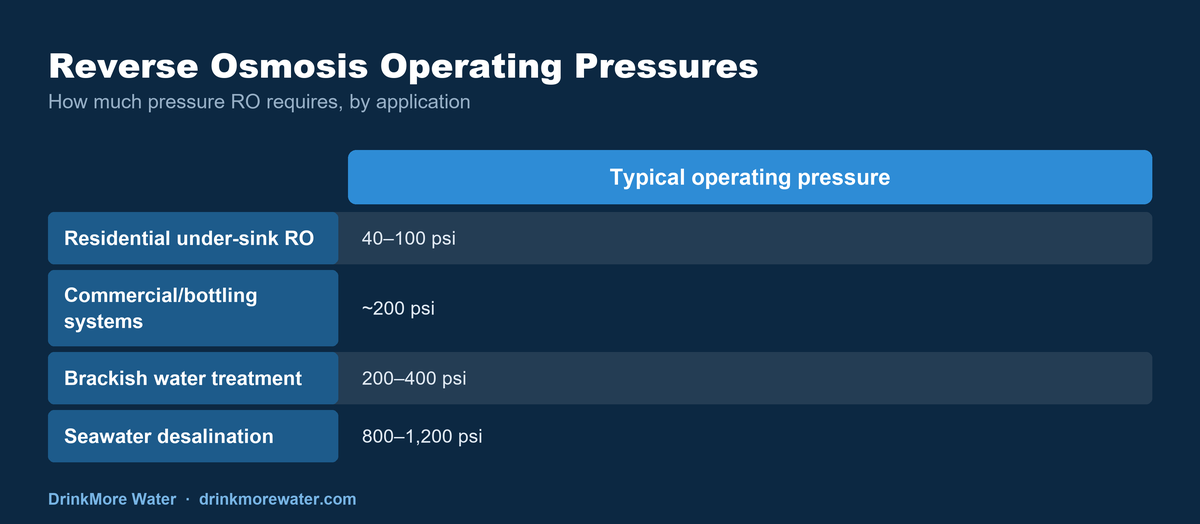
Municipal source water needs far less pressure than seawater because there’s far less dissolved in it to push against. This is also why household RO units struggle on low-pressure supplies — below roughly 40 psi, output slows dramatically.
What Are the Stages of a Reverse Osmosis System?
A membrane alone is not a system. Here’s the full sequence, and why each stage exists.
Stage 1: Sediment Pre-Filtration
Water first passes through a sediment filter, typically rated at 5 microns or finer, that captures rust, silt, and particulate matter.
The purpose is protection. Suspended solids reaching the membrane surface foul it, reducing flow and shortening its life. Sediment filtration is cheap; membranes are not.
Stage 2: Activated Carbon
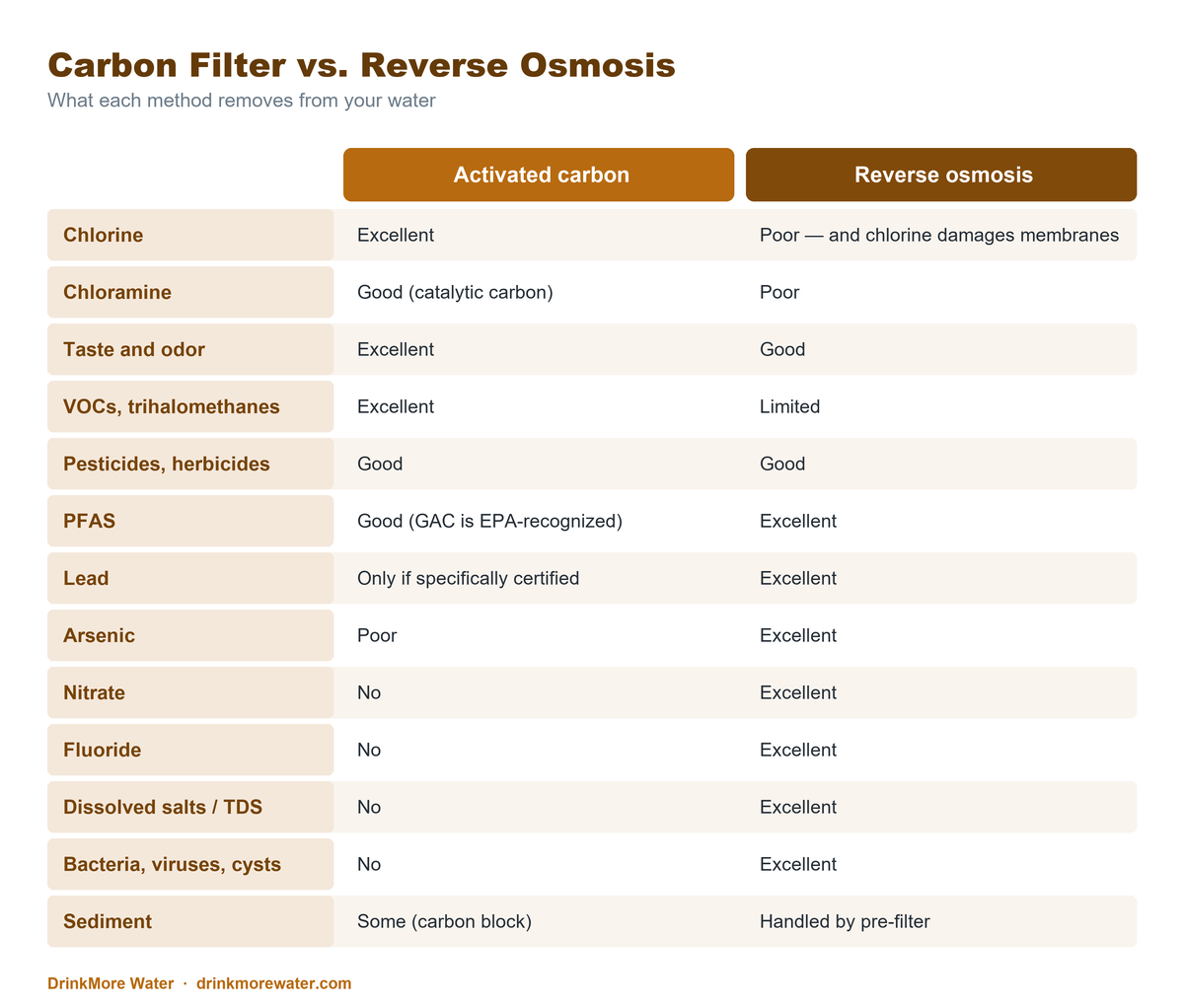
Carbon removes chlorine and chloramine, plus volatile organic compounds and the taste and odor compounds that survive municipal treatment.
This stage is not optional, and the reason is chemical rather than aesthetic. Chlorine oxidizes and destroys polyamide RO membranes. A thin-film composite membrane exposed to chlorinated water degrades quickly and permanently. Every properly designed RO system removes chlorine before the membrane, without exception.
Carbon also handles contaminants RO handles poorly — small uncharged VOCs like chloroform and other trihalomethanes pass through membranes more readily than most dissolved substances.
Stage 3: The Reverse Osmosis Membrane
This is where separation happens.
Modern membranes are thin-film composite sheets: a dense polyamide rejection layer bonded to a porous support. The sheets are wound spirally around a central collection tube inside a pressure vessel — the industry calls these spiral-wound elements.
Pressurized water enters the vessel. Water molecules pass through the polyamide layer and spiral inward to the collection tube as permeate — the purified product. Everything rejected stays in the feed stream and exits as concentrate.
Rejection works by two mechanisms simultaneously: size exclusion (most dissolved ions and molecules are simply too large for the pore structure) and charge repulsion (the membrane surface carries a charge that repels ions).
That dual mechanism is why RO is broad-spectrum. Commercial systems typically reject 95–99% of total dissolved solids.
Stage 4: Post-Treatment and Disinfection
Permeate is pure but not yet finished. Post-treatment varies by application: storage, additional polishing, remineralization in some products, and disinfection.
Disinfection matters because RO produces water with no residual protection. There’s no chlorine left to prevent recontamination downstream, so something else has to keep the system sanitary.
What Happens to the Water That Doesn’t Pass Through?
The concentrate stream — sometimes called reject or brine — carries away everything the membrane rejected.
This is the honest weak point of consumer RO. Typical under-sink units discharge three to four gallons of concentrate for every gallon of permeate produced. Some efficiency-focused residential units do better; many don’t.
Commercial systems are engineered around the problem. Larger membrane arrays, staged configurations where the concentrate from one stage becomes feed for the next, and concentrate recovery all improve recovery ratios substantially over residential equipment.
Worth weighing against the alternative: distillation reaches similar purity but requires boiling every gallon and condensing it back. RO gets there for a fraction of the energy — which is exactly why we built our plant around it.
How Does Reverse Osmosis Work in a Commercial Plant?
Household and production RO share the physics and little else.
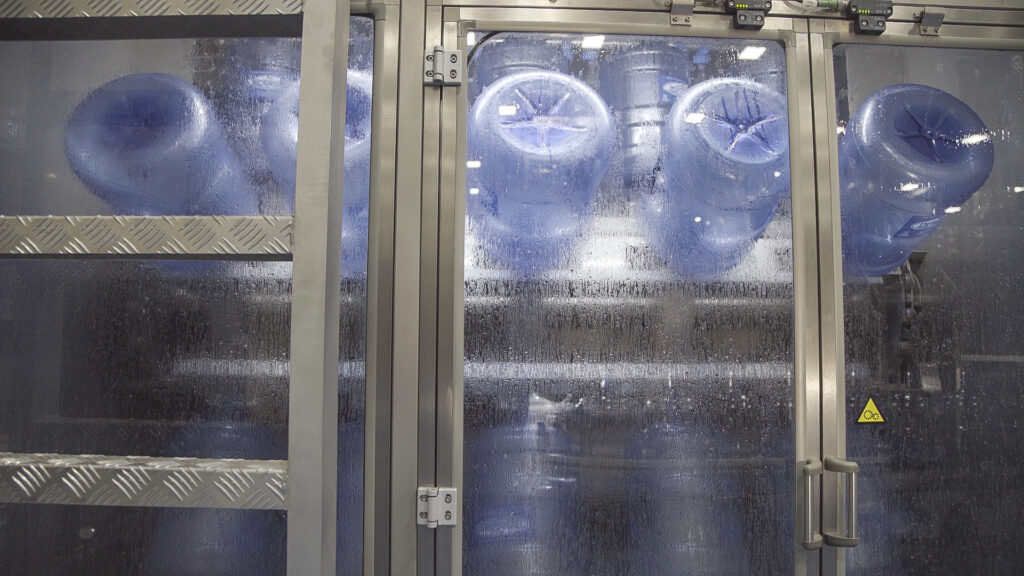
At our Gaithersburg facility, incoming municipal water moves through pre-filtration carbon treatment before reaching any membrane. From there, every drop passes through roughly twenty layers of reverse osmosis membranes — not the single element under a kitchen sink.
Quality control runs continuously rather than periodically. If purity varies from specification even slightly, an alarm triggers and the entire system shuts down automatically. There’s no scenario where out-of-spec water quietly reaches a bottle.
Because our process removes all chlorine, we use two chemical-free disinfection technologies instead:
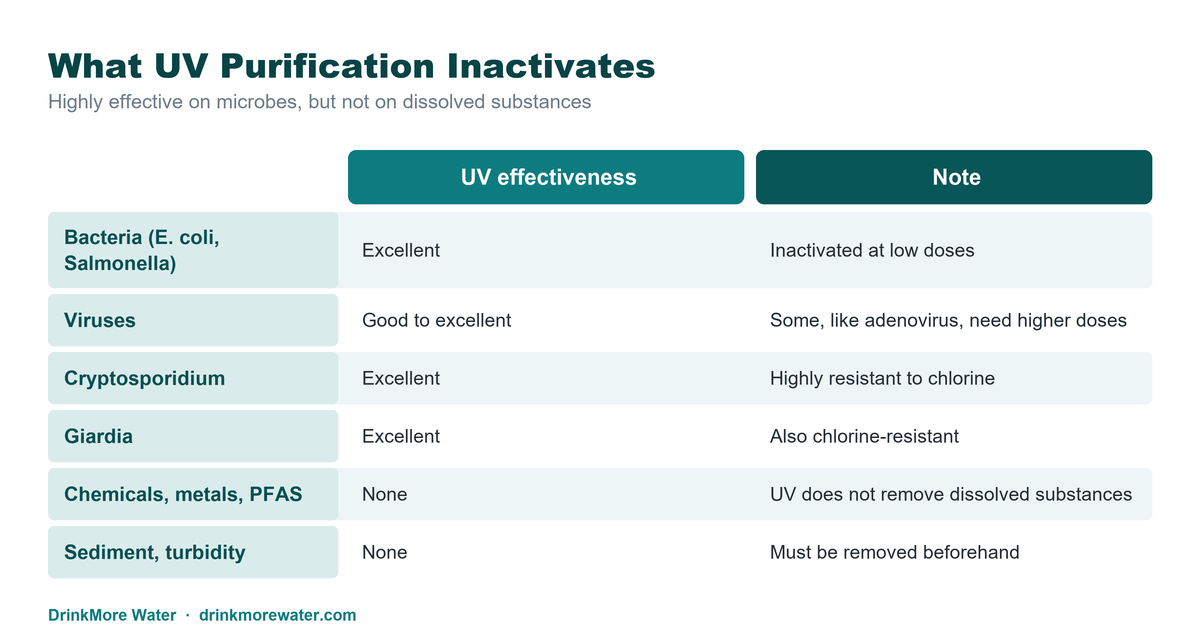
Ultraviolet light. Water passes through chambers housing UV lamps. At germicidal wavelengths, the light destroys the genetic material inside any microorganism present, preventing reproduction. A final UV pass occurs before water reaches our stainless steel storage tanks. More on this in our guide to UV water purification.
Ozone. Introduced right at the reverse osmosis exit , ozone keeps every downstream surface sanitary. It’s a powerful oxidizer effective against organisms like Cryptosporidium that resist chlorination entirely, and it decomposes back into ordinary oxygen — no chemical residue.
Finished water is bottled at approximately 1.2 ppm total dissolved solids.
The complete process documentation lives on our water purification process page, and you can see the equipment on our bottling plant page.
How Do You Know an RO System Is Actually Working?
Three measurements, in order of usefulness.
TDS meter reading. A handheld TDS meter comparing feed water to permeate gives you rejection rate in seconds. If your tap reads 200 ppm and your RO output reads 10 ppm, you’re getting 95% rejection. Rising permeate TDS over time signals a failing membrane.
Flow rate. Declining output at constant pressure usually means fouling or scaling.
Independent lab testing. TDS tells you the aggregate; it says nothing about specific contaminants. Only a laboratory can tell you whether lead, PFAS, or nitrate are present, and at what levels.
We publish our complete Eurofins results on our water analysis page rather than a summary. One detail worth carrying into any comparison: a non-detect result only means something alongside the lab’s reporting limit. Non-detect at 20 ppt and non-detect at 2 ppt are very different statements.
What Maintenance Does Reverse Osmosis Require?
For residential systems:
The membrane interval depends heavily on whether you keep up with the pre-filters. Skip carbon changes and chlorine reaches the membrane, which shortens a five-year component to a much shorter one.
This is the real difference between owning equipment and buying the output. An under-sink system is a maintenance commitment with no one testing whether it still works between service visits. Delivered purified water moves the equipment, the monitoring, and the third-party testing onto the bottler.
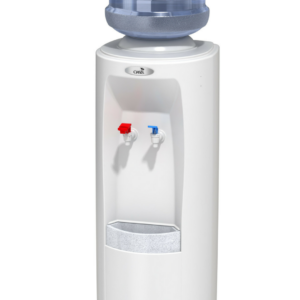
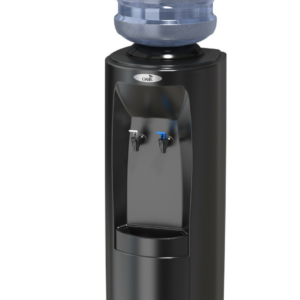
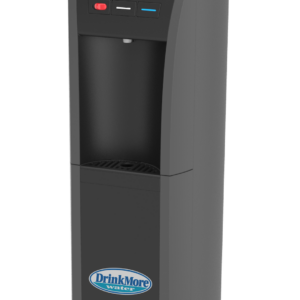
If you’d rather not run the maintenance schedule yourself, our home water delivery service covers households throughout DC, Maryland, and Northern Virginia, and our bottleless water coolers plumb into your existing line. Both are at DrinkMore Water. For offices and events, DrinkMore Custom Water bottles the same water under custom labels.
For background on the technology itself, start with what is reverse osmosis, and see reverse osmosis vs. carbon filter for how the stages compare.
The Bottom Line on How Reverse Osmosis Works
Reverse osmosis works by overcoming osmotic pressure with applied force, pushing water through a semi-permeable membrane that rejects dissolved contaminants by size and charge. A complete system runs sediment filtration, carbon (which protects the membrane from chlorine), the membrane itself, and post-treatment disinfection.
The membrane does the separation. The stages around it are what keep the membrane alive and the finished water safe — which is why no serious operation runs RO alone.
Frequently Asked Questions
How does reverse osmosis actually separate contaminants?
Two mechanisms work simultaneously. Size exclusion blocks dissolved ions and molecules too large for the membrane’s pore structure, roughly 0.0001 microns. Charge repulsion pushes away ions that carry an electrical charge, since the membrane surface is itself charged. Together they produce 95–99% rejection of total dissolved solids.
How many stages does a reverse osmosis system have?
Most systems use four: sediment pre-filtration to protect the membrane from particles, activated carbon to remove chlorine that would destroy the membrane, the reverse osmosis membrane itself, and post-treatment. Commercial systems add multiple membrane passes and disinfection stages. Our plant runs water through roughly twenty membrane layers.
Why does reverse osmosis need a carbon filter first?
Chlorine oxidizes and permanently damages polyamide RO membranes. Carbon removes chlorine and chloramine before water reaches the membrane, protecting it. Carbon also handles small volatile organic compounds like chloroform that pass through RO membranes more easily than most dissolved contaminants.
How much water does reverse osmosis waste?
Residential systems typically discharge three to four gallons of concentrate per gallon of purified water. Commercial systems recover far more through staged membrane arrays and concentrate recovery. The concentrate carries away the rejected contaminants, so some discharge is inherent to how the process works.
How do I test whether my RO system is working?
A handheld TDS meter comparing your tap water to your RO output gives an immediate rejection rate — 200 ppm in and 10 ppm out is 95% rejection. Rising output readings signal membrane failure. TDS won’t identify specific contaminants, though; only laboratory testing can confirm lead, PFAS, or nitrate levels.
How long does a reverse osmosis membrane last?
Two to five years in residential use, depending on source water quality and pre-filter maintenance. Sediment and carbon filters need replacing every six to twelve months. Neglecting carbon changes lets chlorine reach the membrane and shortens its life substantially.
What to Expect
Discover the Difference

30 years Experience

Fast Turnaround Time

Excellent Customer Service

State-Of-The-Art Purification

Made in the USA

Delivered to you!
Testimonials

“10 out of 10. Delivery guy is the best!”
“Excellent water, excellent service all around! Have been using them for years.”
“Very reliable company. Delivers as promised.”
“Everyone here is always nice and accommodating. Never waited and I get unloaded quickly.”
Request Form
We would love to hear from you! Please fill out this form and we will get in touch with you shortly.