Spring Water vs. Purified Water: What Actually Separates Them
What’s the Difference Between Spring Water and Purified Water?
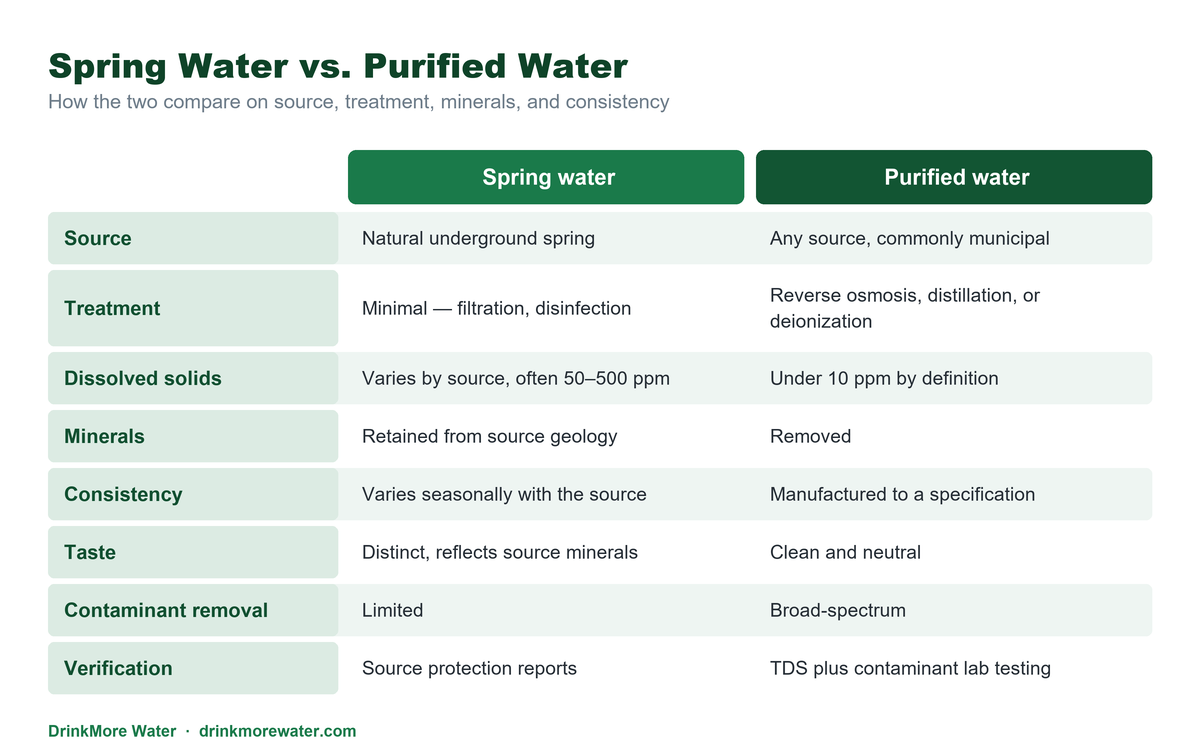
Spring water vs. purified water comes down to source and treatment. Spring water is collected from an underground formation flowing naturally to the surface and receives minimal treatment, retaining the minerals its geology contributed. Purified water is treated by reverse osmosis or distillation until it contains no more than 10 parts per million total dissolved solids, regardless of where it started.
How Does the FDA Define Each Type?
These are legal definitions, not marketing terms, which makes them a reliable starting point.
Spring water must come from an underground formation from which water flows naturally to the earth’s surface. It has to be collected at the spring itself or through a borehole tapping the same underground formation. Treatment is typically limited to filtration and disinfection.
Purified water must be produced by distillation, deionization, reverse osmosis, or a comparable process, and must meet the U.S. Pharmacopeia definition of purified water — no more than 10 ppm total dissolved solids. The source is usually municipal water, which matters less than people assume once 99% of dissolved content has been removed.
A useful consequence: “spring water” tells you where the water came from and almost nothing about what’s in it. “Purified water” tells you what’s in it and almost nothing about where it came from.
Spring Water vs. Purified Water: Side-by-Side
For the wider category landscape — mineral, artesian, alkaline, distilled — see our pillar guide to the types of water.
Which Has More Minerals?
Spring water, by a wide margin.
Spring water carries dissolved calcium, magnesium, sodium, bicarbonate, and trace elements picked up from the rock formations it passed through. That mineral content is the source of its distinctive taste — a specific spring water tastes the way it does because of specific geology.
Purified water has essentially none. Reverse osmosis membranes cannot distinguish calcium from lead; everything dissolved is removed together.
Whether that matters nutritionally is the real question, and the answer is: less than the marketing suggests.
Drinking water is a minor contributor to mineral intake compared with food. The calcium in a liter of typical spring water is a fraction of what a serving of dairy or leafy greens delivers. For someone eating a varied diet, the difference between spring and purified water is not nutritionally significant.
Where it does matter is taste. If you enjoy the mineral character of a particular spring water, that’s a legitimate reason to prefer it. We examine the research in our article on minerals in drinking water.
Which Is Cleaner?
Purified water, measurably — but the comparison needs a caveat.
Reverse osmosis removes 95–99% of dissolved solids, including lead, arsenic, nitrate, PFAS, pesticide residues, pharmaceutical traces, and microbiological contaminants. It’s one of very few technologies that removes dissolved contaminants rather than just suspended particles.
Spring water receives minimal treatment by design. The premise is that the source is naturally clean and protected. Often it is. But whatever else is in that aquifer travels with the minerals, and the treatment applied isn’t intended to remove dissolved contaminants.
The caveat: “cleaner” is only demonstrable through testing. A spring water with published, comprehensive lab results is a better-verified product than a purified water with no published testing at all. The category tells you what treatment occurred. The lab report tells you what’s actually in the bottle.
That’s the question worth asking either way — not “spring or purified?” but “where is the lab report, and what were the reporting limits?”
Which Is More Consistent?
Purified water, and this is an underrated distinction.
Spring water composition shifts with rainfall, drought, and seasonal groundwater changes. Two bottles from the same spring six months apart are chemically similar but not identical. That variation is part of what makes spring water a natural product.
Purified water is manufactured to a specification and verified continuously against it. At our Gaithersburg plant, every drop passes through roughly twenty layers of reverse osmosis membranes, and if purity drifts from spec even slightly, an alarm triggers and the entire system shuts down. The water in January matches the water in July.
If you value predictability — particularly for infant formula preparation, medical considerations, or simply knowing what you’re getting — that consistency is the practical advantage.
Which Tastes Better?
Neither, universally. They taste different, and preference splits genuinely.
Spring water tastes like its source. Mineral content gives it body and a distinctive character that some people specifically seek out.
Purified water tastes clean and neutral. Removing dissolved solids removes the chlorine, metallic, and mineral notes that give other water its local character.
Blind tastings are the fairest test available. The Berkeley Springs International Water Tasting, the longest-running competition of its kind, judges waters within their category — purified against purified, spring against spring — across appearance, aroma, taste, mouthfeel, and aftertaste. DrinkMore Water won gold in the purified category at the 35th competition in February 2025, our first year entering, against more than 80 entries from four continents. Details are on our awards page.
The practical advice is unglamorous: buy one of each and see which one you finish.
Which Costs More?
Spring water generally costs more per gallon at retail, and transport is the main reason. Water is heavy, and spring water must be bottled at its source — which may be hundreds or thousands of miles from you. Premium imported spring and mineral waters carry that distance in their price and their carbon footprint.
Purified water can be produced anywhere with a suitable water supply. That’s why regional purified bottlers can serve a metro area at lower cost and with a much shorter delivery radius than a national spring water brand shipping from a distant source.
For household volume, delivery in returnable multi-gallon bottles is typically the lowest cost per gallon for either type, since you’re not paying for single-use packaging on every gallon.
Which Should You Choose?
A short decision guide:
Choose spring water if you specifically enjoy the mineral taste of a particular source, you prefer minimally processed products, and the brand publishes credible source and testing data.
Choose purified water if you want maximum contaminant removal, you want consistency batch to batch, you have concerns about lead from older plumbing or documented PFAS in your area, or you’d rather buy from a regional producer than ship water across the country.
For either, ask for the independent lab report and check the reporting limits alongside any non-detect results. Non-detect at 20 ppt and non-detect at 2 ppt are very different claims.
Getting Purified Water Delivered in DC, Maryland, and Virginia
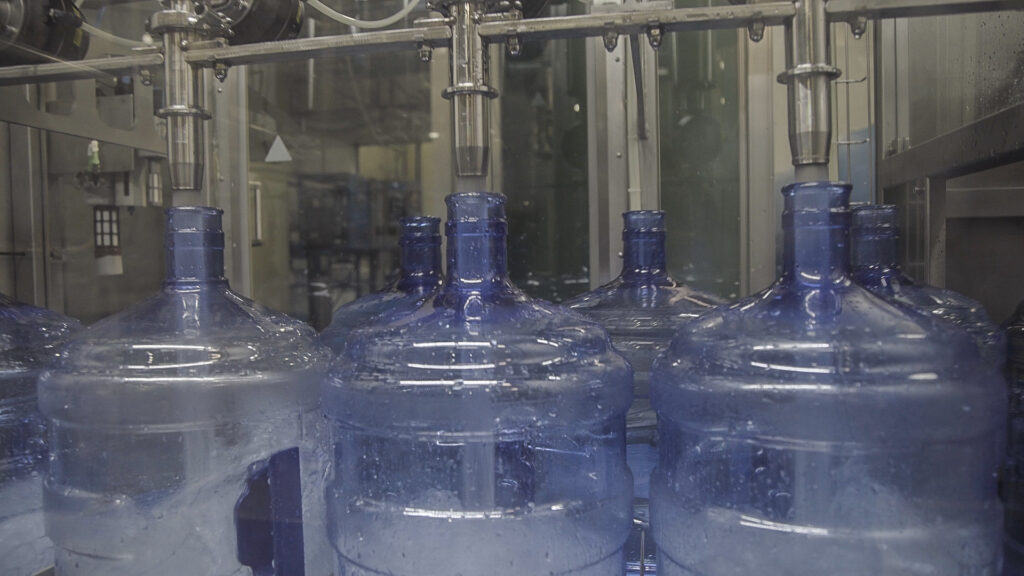
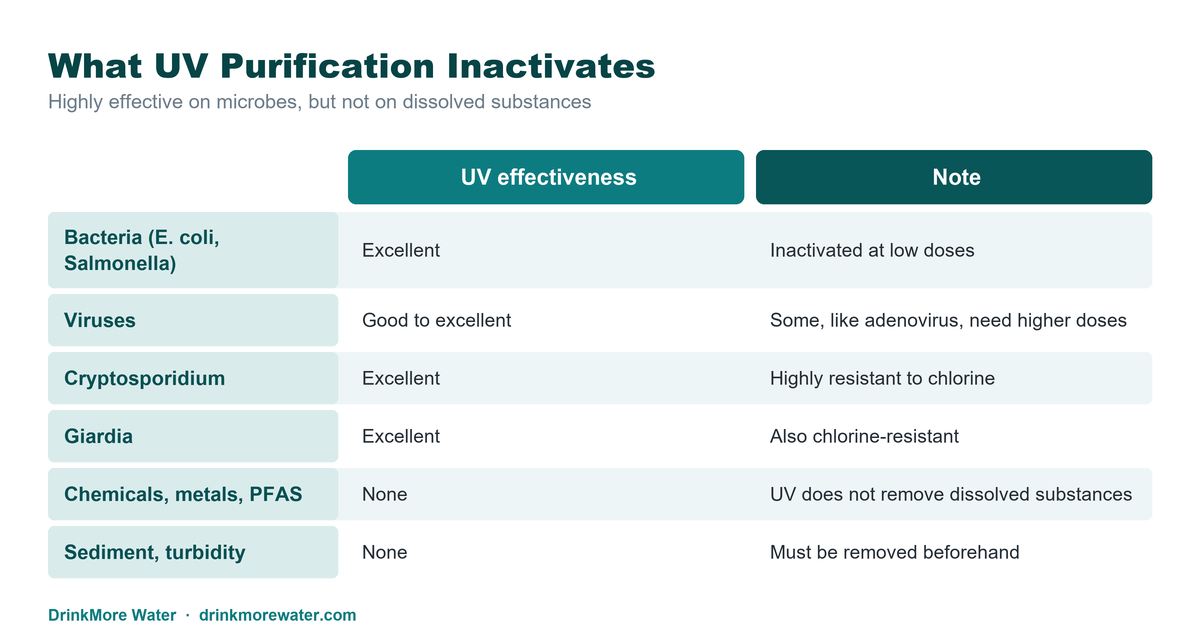
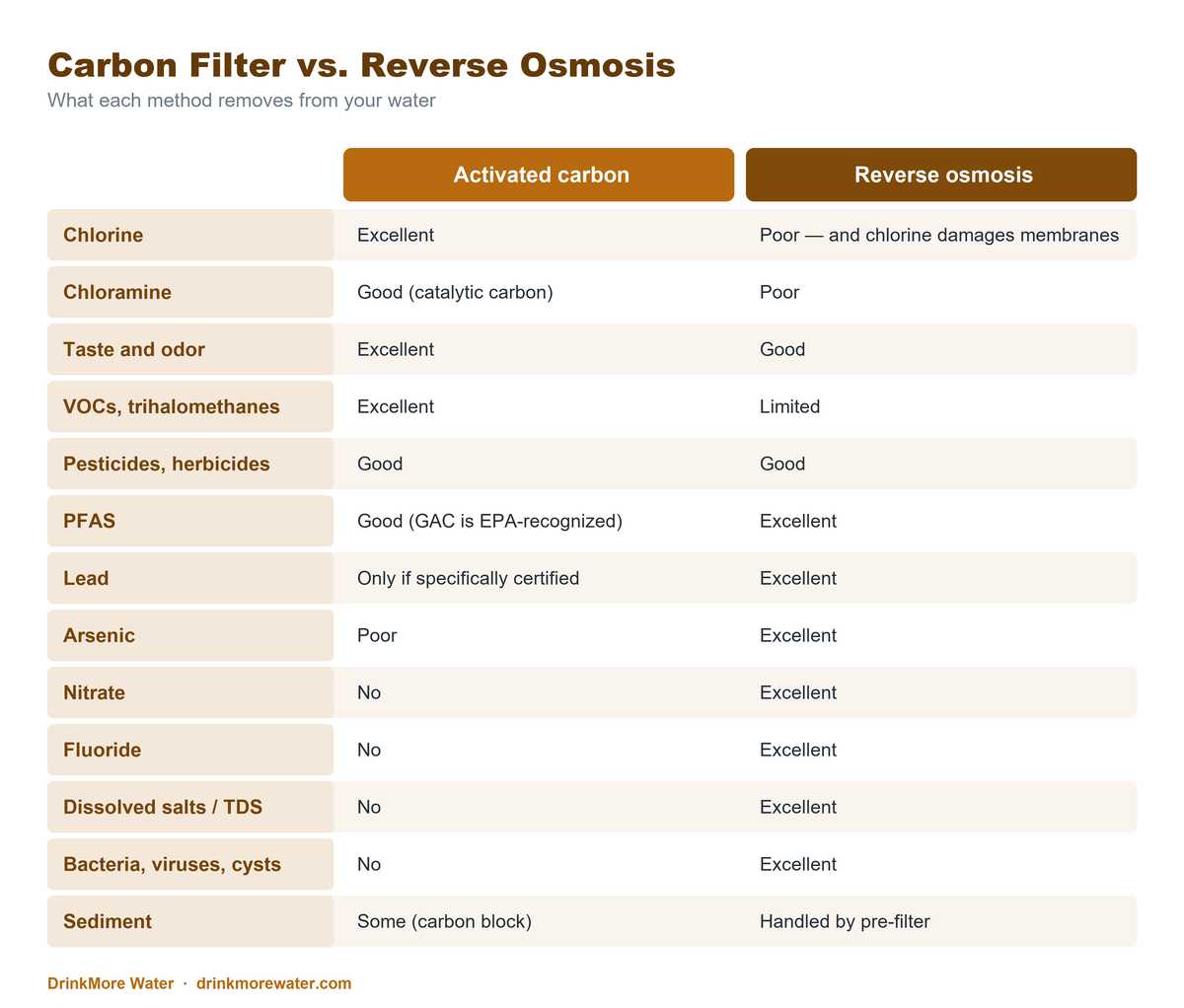
DrinkMore Water purifies by reverse osmosis at our plant in Gaithersburg, Maryland. Incoming water passes through pre-filtration and activated carbon, then roughly twenty layers of RO membranes. Because the process removes all chlorine, we disinfect with ultraviolet light and ozone instead — including a final UV pass before water reaches our stainless steel storage tanks. The full process is on our water purification process page.
We’re tested by Eurofins, an independent accredited laboratory, and we publish the complete report rather than a summary on our water analysis page. Our finished water is bottled at approximately 1.2 ppm total dissolved solids.
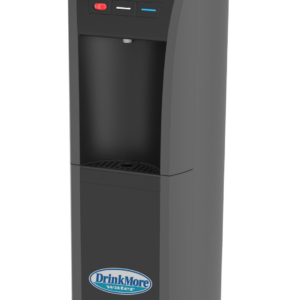
Our home water delivery service covers households across the region, and our bottleless water coolers connect to your existing line if you’d rather skip bottles entirely. Both are at DrinkMore Water. For offices, weddings, conferences, and events, DrinkMore Custom Water bottles the same purified water with your own custom label.
Read the lab report before deciding — that’s the part that should settle it.
The Bottom Line: Spring Water vs. Purified Water
Spring water vs. purified water is a choice between source character and contaminant removal. Spring water gives you naturally occurring minerals, a distinctive taste, and minimal processing, with composition that varies seasonally. Purified water gives you near-zero dissolved solids, broad-spectrum contaminant removal, and batch-to-batch consistency, with the source minerals removed.
Neither is universally better. The brand that publishes its complete testing data is better than the one that doesn’t — and that’s true in both categories.
Frequently Asked Questions
Is spring water better than purified water?
Neither is universally better. Spring water retains naturally occurring minerals and a distinctive taste but receives minimal treatment and varies seasonally. Purified water removes 95–99% of dissolved solids including contaminants, and is consistent batch to batch. Choose based on whether you prioritize source character or contaminant removal.
Does purified water have any minerals?
Very little. To carry the “purified” label, water must contain no more than 10 parts per million total dissolved solids, which includes minerals. Reverse osmosis removes calcium and magnesium along with contaminants because the membrane cannot distinguish between them. Some brands add minerals back afterward for taste.
Is spring water more natural than purified water?
Spring water is less processed — it’s collected from an underground source and typically receives only filtration and disinfection. “Natural” doesn’t automatically mean cleaner, though. Minimal treatment means dissolved contaminants present in the aquifer remain in the bottle. Published lab testing is more informative than either label.
Which is safer for babies and infant formula?
Purified water is often preferred for formula preparation because it contains near-zero dissolved solids and provides consistent composition, which matters when formula is nutritionally balanced already. Nitrate and fluoride levels are relevant considerations. Consult your pediatrician, who can advise based on your specific water supply and formula.
Does spring water cost more than purified water?
Usually, yes. Spring water must be bottled at its source and shipped from there, and water is heavy. Purified water can be produced regionally, which shortens the delivery radius and lowers cost. For both types, delivery in returnable multi-gallon bottles is generally the lowest cost per gallon.
Can spring water contain contaminants?
Yes. Spring water receives minimal treatment by design, so dissolved contaminants present in the source aquifer can remain in the finished product. Protected sources are often genuinely clean, but the only way to know is published testing. Ask for the complete lab report and check reporting limits alongside non-detect results.
What to Expect
Discover the Difference

30 years Experience

Fast Turnaround Time

Excellent Customer Service

State-Of-The-Art Purification

Made in the USA

Delivered to you!
Testimonials

“10 out of 10. Delivery guy is the best!”
“Excellent water, excellent service all around! Have been using them for years.”
“Very reliable company. Delivers as promised.”
“Everyone here is always nice and accommodating. Never waited and I get unloaded quickly.”

Request Form
We would love to hear from you! Please fill out this form and we will get in touch with you shortly.