Reverse Osmosis vs. Carbon Filter: Which Removes What?
Reverse Osmosis vs. Carbon Filter: What’s the Difference?
Reverse osmosis and carbon filtration remove different things by different mechanisms. Reverse osmosis forces water through a semi-permeable membrane, rejecting 95–99% of dissolved solids including metals, nitrate, and salts. Activated carbon adsorbs contaminants onto a porous surface, excelling at chlorine, taste, odor, and organic chemicals but leaving dissolved minerals and salts untouched.
They’re not really competitors. Well-designed systems use both, in sequence, and the order matters.
How Does Each Technology Actually Work?
The mechanisms are fundamentally different, and that difference explains everything about their strengths.
Activated carbon works by adsorption. Carbon is processed to create an enormous internal surface area — a single gram can have 500 to 1,500 square meters of it. Contaminants stick to that surface as water passes through. The key limitation follows directly: adsorption capacity is finite. Once the surface is saturated, the filter stops working, whether or not it looks clean.
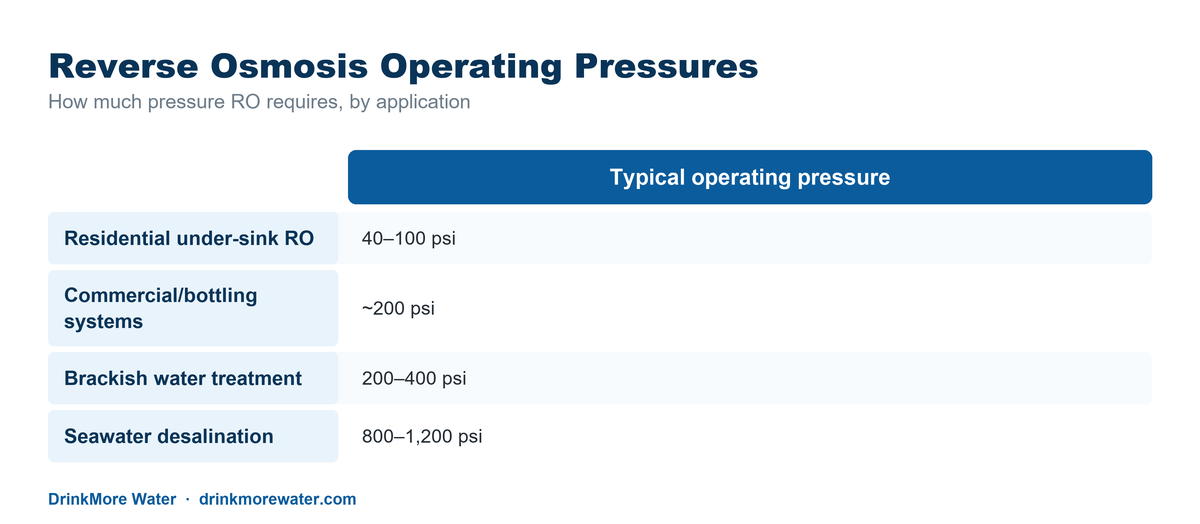
Reverse osmosis works by physical separation. Pressure forces water through a membrane with pores around 0.0001 microns. Dissolved contaminants can’t fit and are rejected by size and by electrical charge, then flushed away as concentrate. Nothing accumulates in the membrane the way it does in carbon — the rejected material leaves.
That’s the core distinction: carbon collects contaminants until it’s full. RO rejects them continuously.
What Does Each Remove?
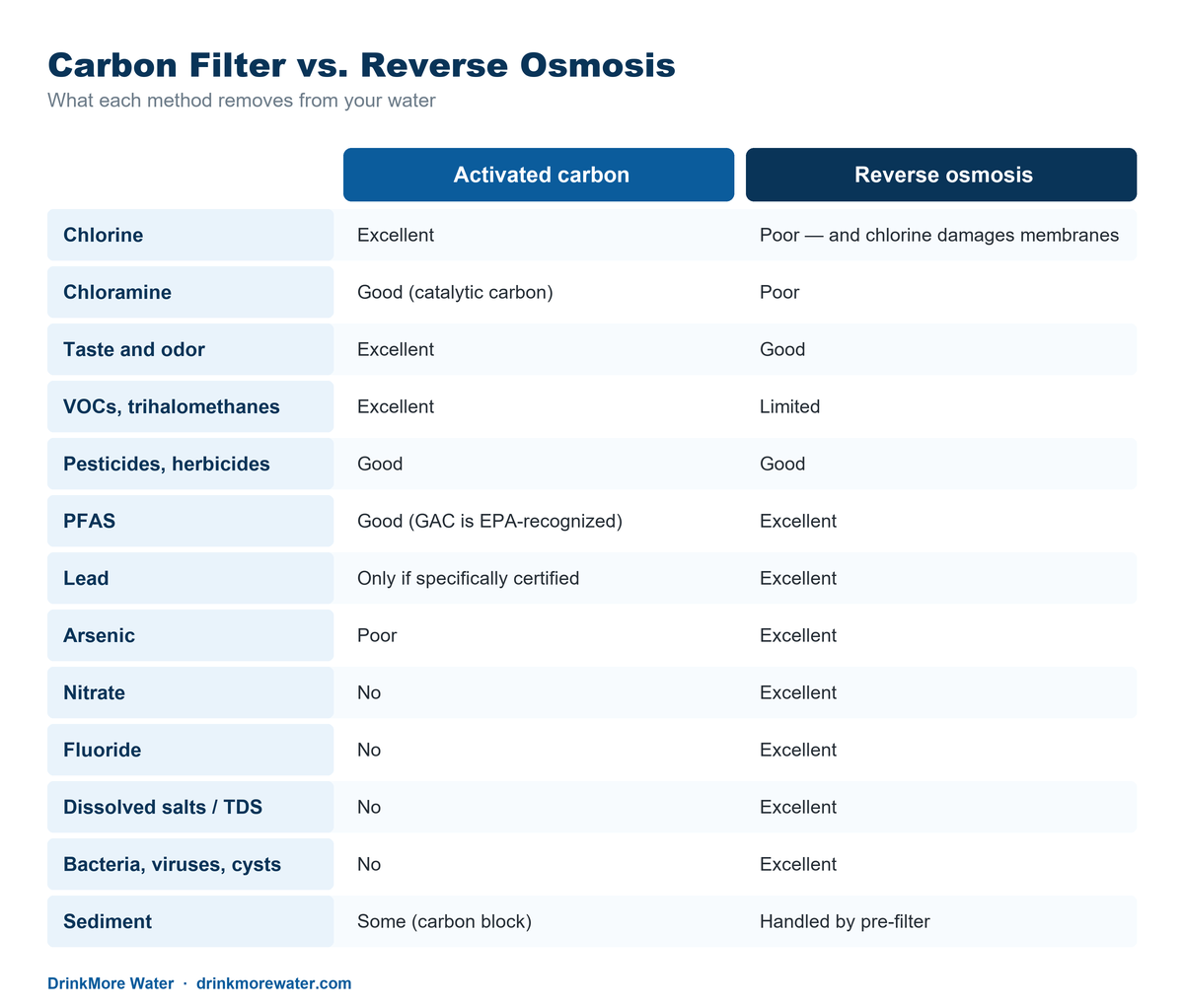
The pattern is clear once you see it laid out: carbon handles organic and volatile compounds; RO handles dissolved inorganic contaminants and pathogens. Their coverage overlaps only slightly.
Which Is Better for Removing Lead?
Reverse osmosis, reliably. Carbon, only sometimes.
RO removes lead as a matter of course — it’s a dissolved metal ion, exactly what the membrane rejects.
Standard carbon filters do not remove lead. Some carbon block filters are specifically engineered and certified for lead reduction, typically by incorporating additional media. The certification is the thing to look for; “carbon filter” alone tells you nothing about lead performance.
This matters in older housing stock. Lead enters water from service lines and household plumbing after it leaves the treatment plant, so no utility report will tell you what’s coming out of your particular faucet. Homes built before 1986 are where the question is live.
Which Is Better for PFAS?
Both work, and the EPA recognizes both — granular activated carbon and reverse osmosis are two of the three technologies the agency identifies as capable of meeting the federal PFAS standards. Ion exchange is the third.
The practical difference is capacity behavior. Carbon adsorbs PFAS until its capacity is exhausted, and performance declines as it saturates — often without any visible sign. RO rejects PFAS continuously and doesn’t saturate the same way.
For point-of-use products, look for certification specifically to NSF/ANSI standards covering PFAS reduction. A general “filtered water” claim means nothing here. Our full guide covers PFAS in drinking water.
Why Do Systems Use Both — and in What Order?
Carbon goes first, always. The reason is protective rather than performance-related.
Chlorine oxidizes and destroys polyamide RO membranes. A thin-film composite membrane exposed to chlorinated water degrades quickly and permanently. Carbon removes chlorine before the water ever reaches the membrane.
There’s a second reason. RO handles small, uncharged volatile organic compounds relatively poorly — chloroform and other trihalomethanes pass through more readily than most dissolved contaminants. Carbon catches them. So the carbon stage isn’t just membrane insurance; it covers a genuine gap in RO’s coverage.
Run in sequence, the two technologies cover nearly the full contaminant spectrum. That’s why every credible purification system is multi-stage rather than built around one technology. We explain the broader distinction in water purification vs. filtration.
How This Works at Production Scale
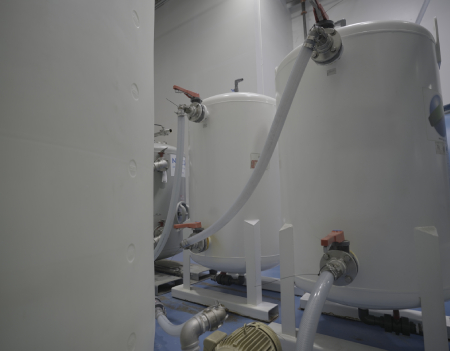
At our Gaithersburg, Maryland plant, the sequence is the same one described above, just larger.
Incoming municipal water passes through pre-filtration and activated carbon first — carbon strips the chlorine that would otherwise destroy our membranes. Every drop then passes through roughly twenty layers of reverse osmosis membranes rather than the single element in a residential unit. If purity varies from specification, an alarm triggers and the entire system shuts down automatically.
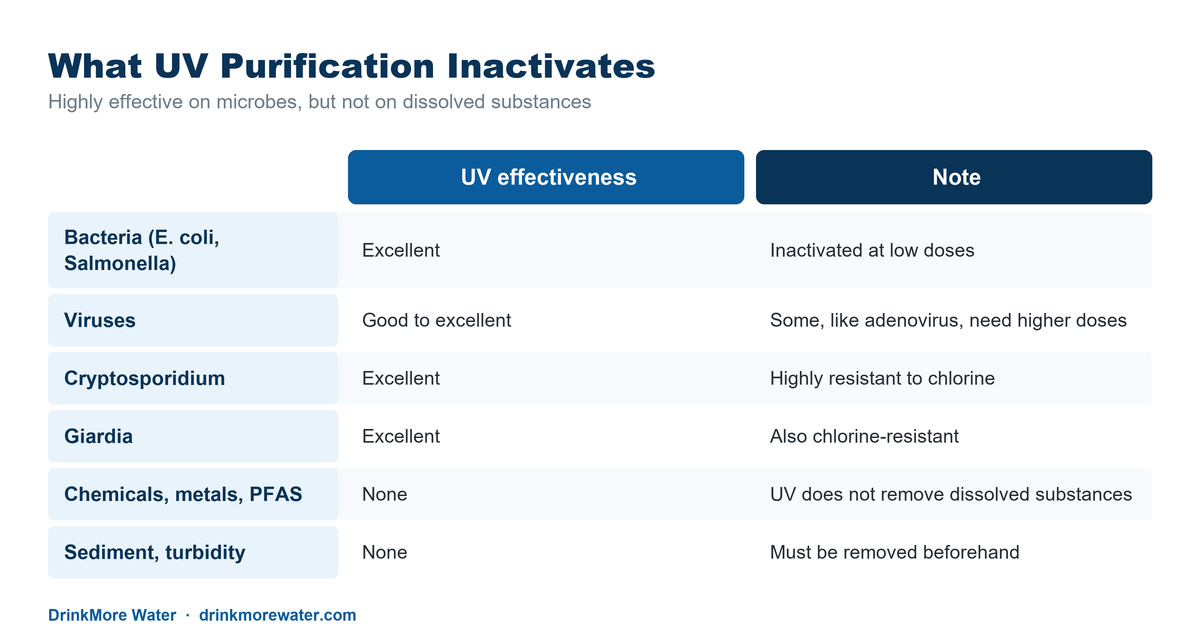
Because the process removes all chlorine, there’s no disinfectant residual left to protect the water downstream. So we use two chemical-free technologies instead: ultraviolet light, including a final pass before water reaches our stainless steel storage tanks, and ozone, introduced at the reverse osmosis exit and used at several points to keep the system sanitary.
The full walkthrough is on our water purification process page. For the underlying technology, see what is reverse osmosis and how does reverse osmosis work.
Cost, Maintenance, and Practical Tradeoffs
That last row deserves attention. A saturated carbon filter looks identical to a fresh one and gives no indication it has stopped working. An RO membrane’s decline shows up as a rising TDS reading, which you can check yourself with an inexpensive handheld meter.
Both, though, share the same underlying issue: they only perform if someone maintains them on schedule, and no one is independently verifying your output.
Which Should You Choose?
A carbon filter is enough if your only concern is chlorine taste and odor, your utility reports clean results, and your plumbing is post-1986. It’s inexpensive, requires no installation, and solves the problem most people actually have.
Reverse osmosis makes sense if you’re concerned about lead from older plumbing, documented PFAS or nitrate in your area, or you want the broadest possible contaminant removal.
Delivered purified water makes sense if you’d rather not own and maintain equipment at all. It shifts the membranes, the monitoring, and the independent lab testing onto the bottler — and you get results you can read.
We publish our complete Eurofins lab report, not a summary, on our water analysis page. Our home water delivery service covers households across DC, Maryland, and Northern Virginia, and our bottleless water coolers purify at the point of use if bottles aren’t your preference. Both are at DrinkMore Water. For offices and events, DrinkMore Custom Water offers the same water under custom labels.
Start with your utility’s Consumer Confidence Report either way. Your own numbers should drive the decision.
The Bottom Line: Reverse Osmosis vs. Carbon Filter
Reverse osmosis vs. carbon filter isn’t really a choice between rivals. Carbon excels at chlorine, taste, odor, and volatile organic compounds but cannot remove dissolved salts, metals, nitrate, or pathogens. Reverse osmosis removes all of those but handles some VOCs poorly and is destroyed by chlorine.
Used together in the right order — carbon first, then the membrane — they cover almost everything. Used alone, each leaves a gap the other would have filled.
Frequently Asked Questions
Is reverse osmosis better than a carbon filter?
For breadth of contaminant removal, yes — RO removes dissolved metals, nitrate, fluoride, salts, and pathogens that carbon cannot touch. But carbon outperforms RO on chlorine and volatile organic compounds, and carbon is required to protect RO membranes from chlorine damage. Complete systems use both in sequence.
Does a carbon filter remove lead?
Only if specifically certified for it. Standard activated carbon does not remove lead. Certain carbon block filters incorporate additional media and are certified for lead reduction. Look for that certification explicitly — the phrase “carbon filter” alone tells you nothing about lead performance. Reverse osmosis removes lead reliably.
Why does reverse osmosis need a carbon pre-filter?
Chlorine oxidizes and permanently destroys polyamide reverse osmosis membranes. Carbon removes chlorine and chloramine before water reaches the membrane. Carbon also captures small volatile organic compounds like chloroform, which pass through RO membranes more readily than most dissolved contaminants — so it covers a real gap.
Do carbon filters remove PFAS?
Granular activated carbon is one of three technologies the EPA recognizes as capable of meeting federal PFAS standards, alongside reverse osmosis and ion exchange. Effectiveness declines as the carbon saturates, often without visible warning. Look for products certified to NSF/ANSI standards covering PFAS reduction specifically.
How do I know when my carbon filter is exhausted?
You generally can’t tell by looking — a saturated carbon filter appears identical to a fresh one and gives no warning before performance drops. Follow the manufacturer’s replacement interval based on gallons or months. Returning chlorine taste is a late signal, meaning the filter has already been ineffective for some time.
Does reverse osmosis remove chlorine?
Poorly, and it shouldn’t have to. Chlorine is a small molecule that passes through membranes relatively easily, and worse, it oxidizes and damages the membrane itself. Carbon pre-filtration removes chlorine before the RO stage — this is standard design in every properly built system.
What to Expect
Discover the Difference

30 years Experience

Fast Turnaround Time

Excellent Customer Service

State-Of-The-Art Purification

Made in the USA

Delivered to you!
Testimonials

“10 out of 10. Delivery guy is the best!”
“Excellent water, excellent service all around! Have been using them for years.”
“Very reliable company. Delivers as promised.”
“Everyone here is always nice and accommodating. Never waited and I get unloaded quickly.”

Request Form
We would love to hear from you! Please fill out this form and we will get in touch with you shortly.