Health Benefits of Purified Water: What’s Real and What’s Marketing
What Are the Health Benefits of Purified Water?
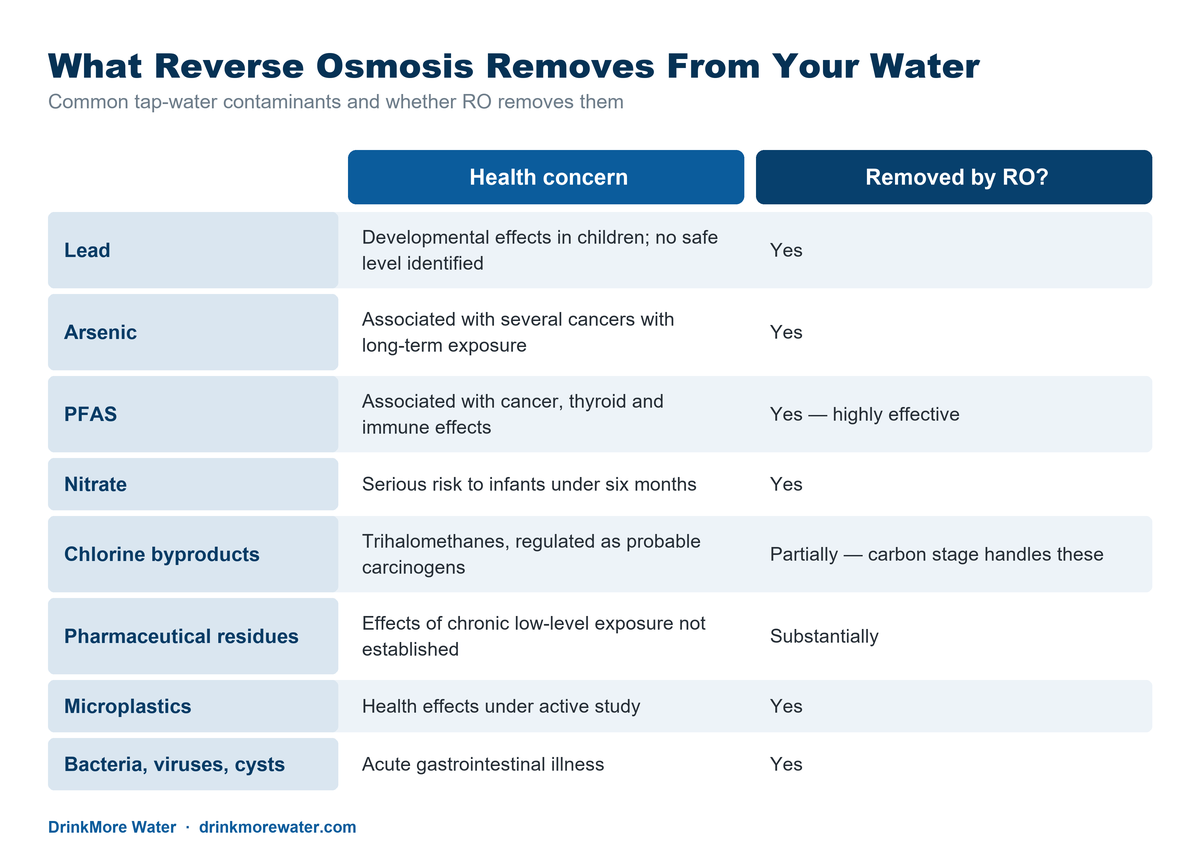
The health benefits of purified water come from contaminant removal rather than any added property. Reverse osmosis eliminates 95–99% of dissolved solids, including lead, arsenic, nitrate, PFAS, and pharmaceutical residues. It also removes chlorine, which improves taste enough that many people drink more water — a real, if indirect, benefit.
That’s the honest version. This article explains what’s genuinely supported, what’s oversold, and how to evaluate any bottler’s claims — including ours.
Is Purified Water Good for You?
Yes, and the mechanism is simpler than most marketing suggests.
Purified water is water with contaminants removed. It contains no special ingredient, no enhanced absorption property, no restructured molecule. Its benefit is subtractive: the things that could harm you are gone.
That framing matters because it sets a realistic expectation. Switching to purified water will not raise your energy levels, detoxify your organs, or change your body’s pH. Those claims circulate widely and none of them hold up.
What purified water does do is remove exposure to specific contaminants that are worth avoiding — and that’s a genuine health benefit, just a narrower one than the industry often implies.
What Contaminants Does Purified Water Remove?
Reverse osmosis separates contaminants by molecular size and electrical charge, which makes it unusually broad-spectrum. It’s one of the few technologies that removes dissolved contaminants rather than just suspended particles.
Two of these deserve elaboration.
Lead enters water from service lines and household plumbing, not from the treatment plant. Water can leave a utility meeting every federal standard and pick up lead on the way to your faucet. Homes built before 1986 are where this risk concentrates. The CDC and EPA both state there is no known safe level of lead exposure for children.
PFAS are the synthetic “forever chemicals” the EPA began regulating in 2024, with enforceable limits of 4 parts per trillion for PFOA and PFOS. Conventional municipal treatment was never designed to remove them; compliance deadlines for utilities run to 2029 or 2031. Reverse osmosis is one of three technologies the EPA identifies as capable of meeting those standards. Our full guide covers PFAS in drinking water.
For the complete contaminant picture, see what’s in tap water.
Does Purified Water Remove Beneficial Minerals?
Yes — and this is the most common objection, so it deserves a straight answer rather than a deflection.
Reverse osmosis membranes cannot distinguish calcium and magnesium from lead and arsenic. Everything dissolved gets removed together.
The nutritional significance is small for most people. Drinking water is a minor contributor to mineral intake compared with food. The calcium in a liter of typical tap water is a fraction of what a single serving of dairy, leafy greens, canned fish with bones, or fortified foods provides. Magnesium follows the same pattern.
The World Health Organization has examined demineralized drinking water and noted that mineral intake from water is generally modest relative to dietary sources, while acknowledging that in populations with marginal intake it can contribute meaningfully.
The practical takeaway: if your diet is reasonably varied, purified water doesn’t change your mineral status. If you have a diagnosed deficiency, that’s a conversation with your physician about diet and supplementation — not something to solve through drinking water.
We go deeper in our article on minerals in drinking water.
Does Purified Water Help You Drink More?
This is the most underrated benefit and the easiest to verify yourself.
Purification removes chlorine, which is the source of the taste and smell most people associate with tap water. It also removes dissolved metals and minerals that contribute metallic or mineral notes.
Adequate hydration supports temperature regulation, joint lubrication, nutrient transport, kidney function, and cognitive performance. None of that is controversial. The National Academies suggest roughly 15.5 cups of total daily fluid for men and 11.5 cups for women, including water from food.
If better-tasting water means you reach for a glass instead of a soda or an energy drink, the health effect of that substitution is larger than anything attributable to the water’s composition. It’s an indirect benefit, but it’s real, and it’s the one most people actually notice.
What Purified Water Does Not Do
Being direct here is more useful than being promotional.
It does not detoxify your body. Your liver and kidneys handle that
It does not change your body’s pH. Blood pH is tightly regulated within a narrow range. Stomach acid neutralizes anything you drink. This applies to alkaline water too, which we cover in our guide to alkaline water.
It does not boost immunity or metabolism. Adequate hydration supports normal function. Water beyond adequate hydration doesn’t add benefit.
It does not treat or prevent disease. Any brand making disease claims about water is making claims it can’t support.
It is not “hexagonal,” “structured,” or “micro-clustered.” These terms describe no measurable property of water.
A bottler willing to tell you what its product doesn’t do is a bottler you can more reasonably trust about what it does.
How Do You Verify a Purified Water’s Purity?
Everything above is only meaningful if a specific water actually is pure. Here’s how to check.
Look for the purified designation. To be labeled “purified” in the United States, water must meet the U.S. Pharmacopeia standard of no more than 10 parts per million total dissolved solids. That’s a legal definition, not a marketing term.
Ask for the lab report — the actual report. Not a one-page summary. The testing data, with the laboratory named and the reporting limits visible.
Check the reporting limits alongside any non-detect results. This is the detail most people miss. “Non-detect” at a reporting limit of 20 ppt and “non-detect” at 2 ppt are very different statements about the same contaminant. A brand citing non-detects without reporting limits is giving you half the information.
Ask what treatment is used. “Filtered” and “purified” are not synonyms. Filtration removes particles; purification removes dissolved contaminants.
DrinkMore Water is tested by Eurofins, an independent accredited laboratory, and we publish the complete report — not a summary — on our water analysis page. Our finished water is bottled at approximately 1.2 ppm total dissolved solids, well under the 10 ppm purified threshold.
How Purified Water Is Made
Understanding the process makes the claims easier to evaluate.
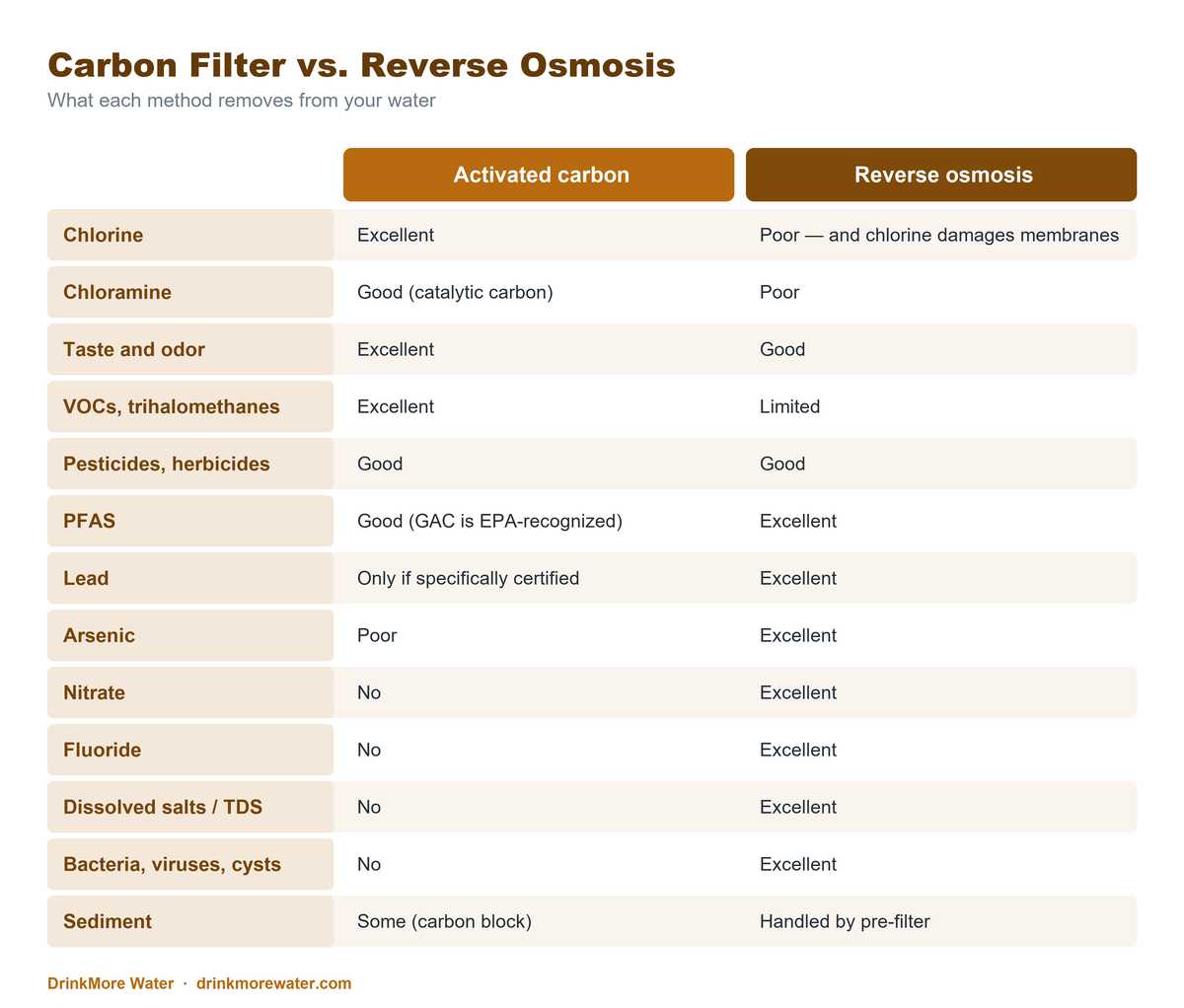
At our Gaithersburg, Maryland plant, incoming municipal water passes through pre-filtration and activated carbon first. Carbon removes chlorine — necessary for taste and because chlorine oxidizes and destroys reverse osmosis membranes.
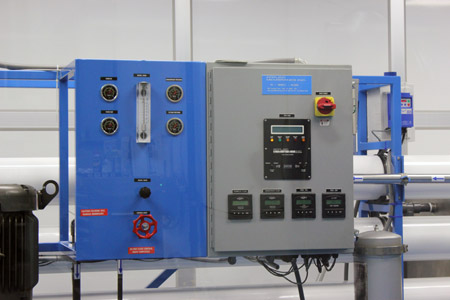
Every drop then passes through roughly twenty layers of reverse osmosis membranes rather than the single element in a residential unit. If purity varies from specification even slightly, an alarm triggers and the entire system shuts down. Out-of-spec water cannot reach a bottle.
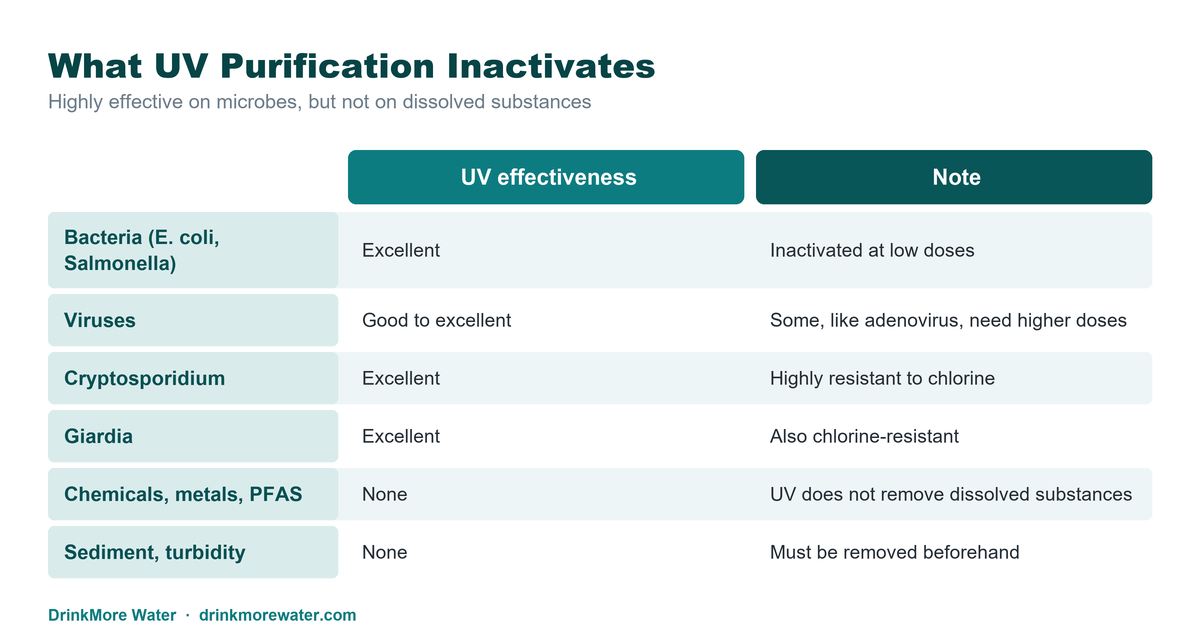
Because our process removes all chlorine, we disinfect with two chemical-free technologies. Ultraviolet light comes first, destroying the genetic material of any microorganism present; a final UV pass occurs before water reaches our stainless steel storage tanks. Ozone is the second layer, introduced at the reverse osmosis exit and used at several points. Ozone oxidizes a broad range of contaminants — including organisms like Cryptosporidium that resist chlorination entirely — then breaks down into ordinary oxygen, leaving no residue.
The full walkthrough is on our water purification process page.
In February 2025, DrinkMore Water won the gold medal for Best Purified Drinking Water at the 35th Berkeley Springs International Water Tasting, judged blind by ten trained media judges against more than 80 entries from four continents. It was the first year we entered. More on our awards page.
Is Purified Water Worth It for Your Household?
The reasonable way to decide: start with your own utility’s Consumer Confidence Report and check your plumbing age. If your water meets standards and your plumbing is post-1986, purified water is mostly a taste and consistency decision. If you have older plumbing, documented PFAS detections, or a household member who’s pregnant, an infant, or immunocompromised, the case for contaminant removal gets stronger.
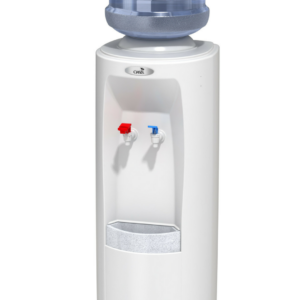
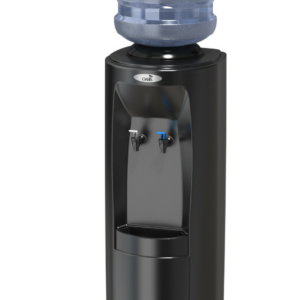
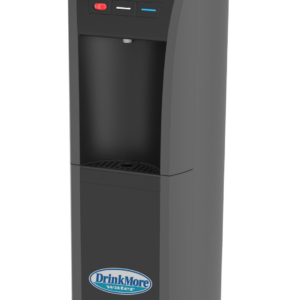
If you decide purified water fits, our home water delivery service covers households throughout DC, Maryland, and Northern Virginia, and our bottleless water coolers purify at the point of use if you’d rather not handle bottles. Both are at DrinkMore Water. For offices and events, DrinkMore Custom Water bottles the same water under custom labels.
Read our lab report first. That’s the part that should decide it.
The Bottom Line on Purified Water and Health
The health benefits of purified water are real but specific: removal of lead, arsenic, PFAS, nitrate, microbiological contaminants, and other dissolved substances, plus improved taste that tends to increase how much water people drink.
Purified water is not a wellness product. It’s water with the contaminants taken out — and the only meaningful way to know whether that’s true of any given brand is to read its independent lab report.
Frequently Asked Questions
Is purified water good for you?
Yes. Purified water is safe and removes contaminants including lead, arsenic, nitrate, PFAS, and microbiological organisms. Its benefits come from what’s removed rather than anything added. Claims that purified water detoxifies the body, boosts metabolism, or alters pH are not supported by evidence.
Does purified water remove healthy minerals?
Yes. Reverse osmosis removes calcium, magnesium, and other minerals along with contaminants, since the membrane cannot distinguish between them. For most people this is nutritionally minor, because drinking water contributes far less mineral intake than food. Those with diagnosed deficiencies should address them through diet and medical guidance.
Is purified water better than tap water for health?
Purified water removes contaminants that municipal treatment isn’t designed to eliminate, particularly PFAS and any lead picked up from household plumbing after water leaves the treatment plant. Most municipal water meets federal standards. The benefit of purified water is greatest where plumbing is older or specific contaminants are documented.
Can drinking purified water cause mineral deficiency?
Not in people eating a varied diet. Drinking water supplies a small share of daily calcium and magnesium relative to food sources like dairy, leafy greens, nuts, and fortified products. The World Health Organization notes mineral intake from water can matter more in populations with marginal dietary intake.
Does purified water taste different from tap water?
Most people find it tastes cleaner and more neutral. Purification removes chlorine, dissolved metals, and minerals — the compounds responsible for the taste and odor associated with tap water. Blind panels do reward it: DrinkMore Water took gold in the purified category at the 2025 Berkeley Springs International Water Tasting.
How do I know if bottled water is actually purified?
Check for the “purified” designation, which legally requires no more than 10 parts per million total dissolved solids. Then ask the bottler for its complete independent lab report, including reporting limits — a non-detect result is only meaningful alongside the limit at which the lab could detect the contaminant.
What to Expect
Discover the Difference

30 years Experience

Fast Turnaround Time

Excellent Customer Service

State-Of-The-Art Purification

Made in the USA

Delivered to you!
Testimonials

“10 out of 10. Delivery guy is the best!”
“Excellent water, excellent service all around! Have been using them for years.”
“Very reliable company. Delivers as promised.”
“Everyone here is always nice and accommodating. Never waited and I get unloaded quickly.”
Request Form
We would love to hear from you! Please fill out this form and we will get in touch with you shortly.