What Is Reverse Osmosis? A Water Operator’s Plain-English Guide
What Is Reverse Osmosis, and How Does It Purify Water?
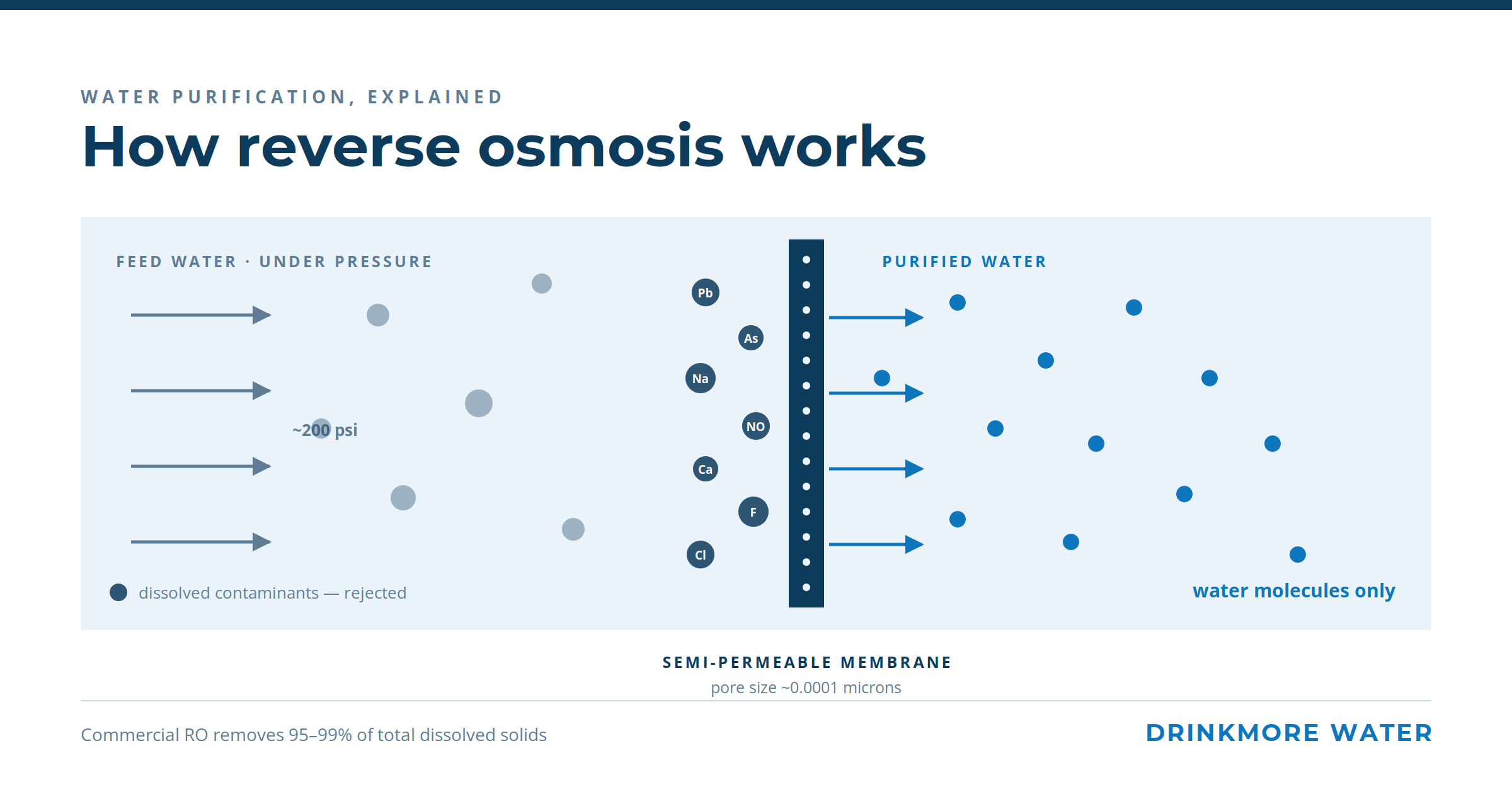
Reverse osmosis is a water purification method that forces water through a semi-permeable membrane under pressure, leaving dissolved contaminants behind. The membrane’s pores are roughly 0.0001 microns wide — small enough to block dissolved salts, metals, and most chemical contaminants while letting water molecules pass. Commercial RO systems typically remove 95–99% of total dissolved solids.
That’s the short answer. Below is the longer one, written by the people who run a water purification plant utilizing two separate reverse osmosis systems every day in Gaithersburg, Maryland.
We’ve operated RO equipment at production scale for decades. This guide covers what the process actually does, what it doesn’t do, and why nearly every serious purified water operation is built around it.
How Does Osmosis Work — and What Makes It “Reverse”?
Osmosis is a natural process. When two solutions of different concentrations sit on either side of a semi-permeable membrane, water moves from the diluted side toward the concentrated side until both sides even out. It’s how plant roots draw water from soil and how your cells manage fluid balance.
Reverse osmosis flips that direction using pressure.
Apply enough force to the contaminated side of the membrane — more than the natural osmotic pressure pushing the other way — and water is driven backward, from the concentrated side to the clean side. The dissolved contaminants can’t follow. They stay behind and get flushed away as concentrate.
Household RO units generally run at 40–100 psi. Commercial systems run considerably higher; industrial bottling operations commonly pressurize to around 200 psi to push adequate volume through the membranes.
What Is an RO Membrane Made Of?
Modern reverse osmosis membranes are thin-film composite sheets, usually a polyamide layer bonded to a porous support. The sheets are wound in a spiral around a central collection tube inside a cylindrical housing, which is why the industry calls them spiral-wound elements.
The first practical RO membrane was developed at UCLA around 1959–1960 by Sidney Loeb and Srinivasa Sourirajan, who figured out how to cast an asymmetric cellulose acetate film that was both selective and fast enough to be useful. The first municipal RO desalination plant in the United States opened in Coalinga, California, in 1965.
What Does Reverse Osmosis Remove From Water?
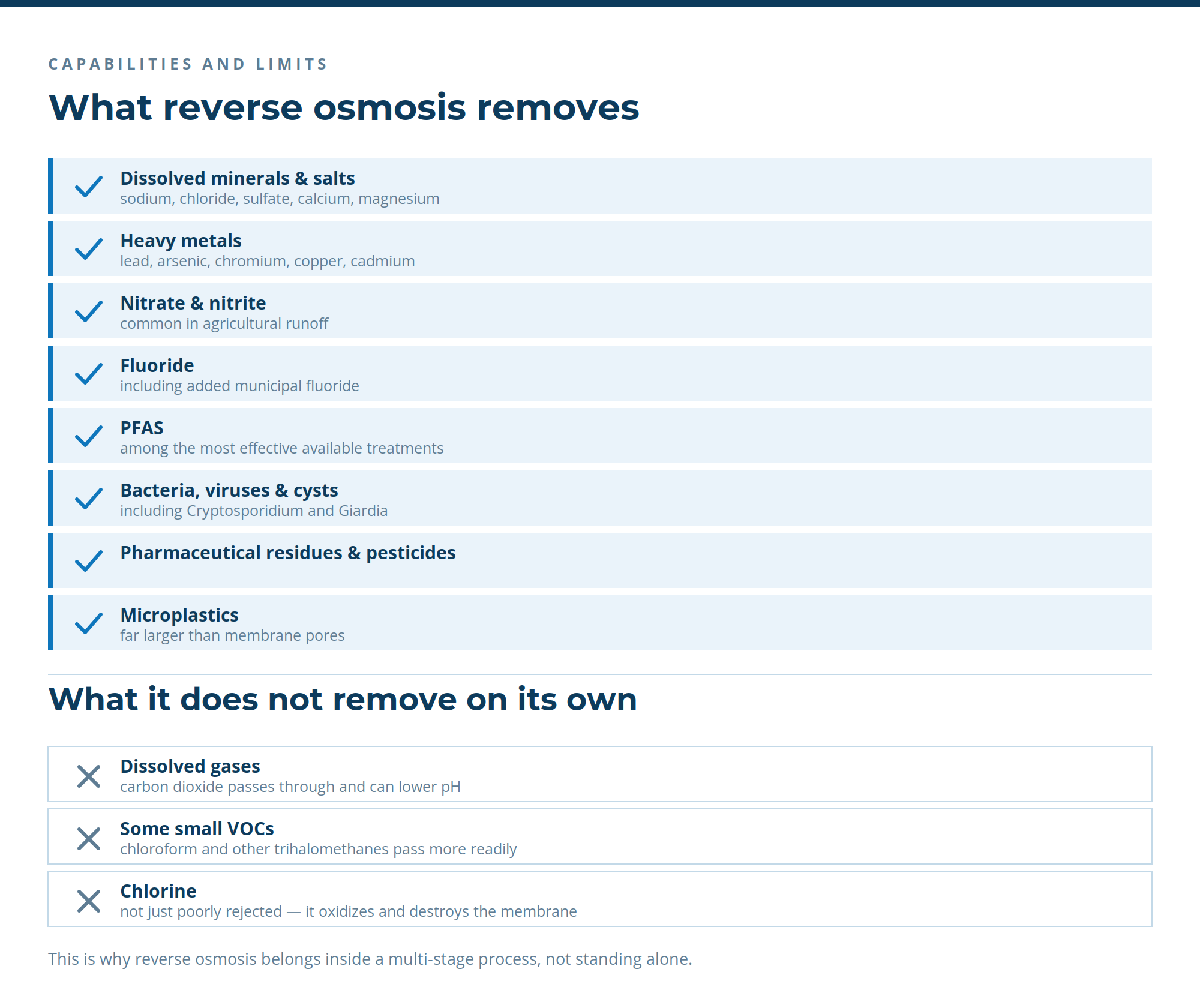
Reverse osmosis separates by molecular size and electrical charge, which makes it unusually broad-spectrum compared with a simple filter. It is one of the few technologies that removes dissolved contaminants rather than just suspended particles.
What Reverse Osmosis Does Not Remove
That’s the core reason a real purification process is multi-stage. RO is the centerpiece, not the whole building.
Reverse Osmosis vs. Other Water Treatment Methods
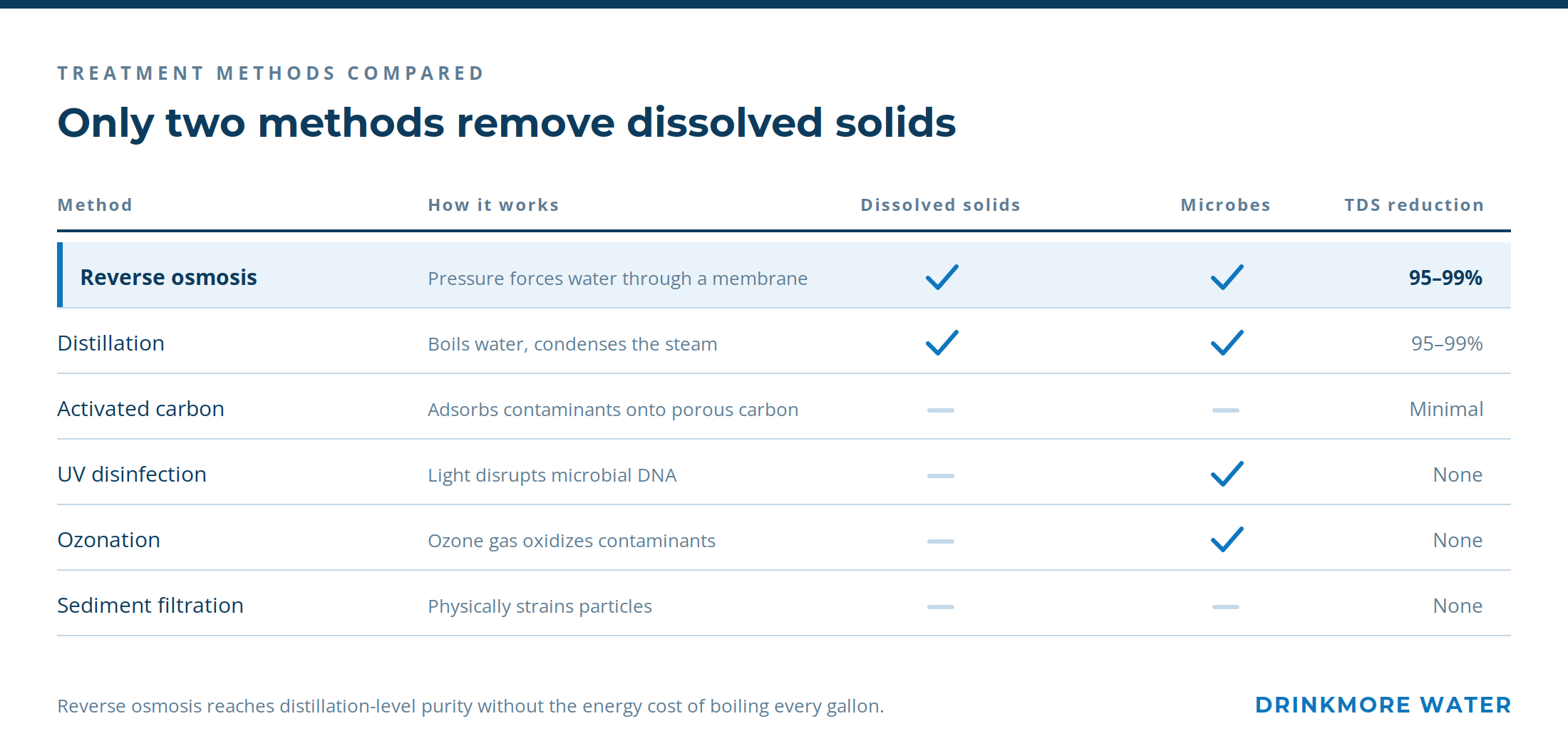
The pattern is worth noticing: carbon, UV, ozone, and sediment filtration each do one job well and nothing else. Only reverse osmosis and distillation actually reduce dissolved solids — and RO does it using substantially less energy, since it never has to boil anything. This is why DrinkMore Water utilizes our current production flow to produce the purest water on the planet.
If you want a deeper comparison of those two, we wrote a full breakdown of distilled versus purified water. For the wider landscape of water categories, our guide to the different types of water covers spring, mineral, alkaline, and purified side by side.
Is Reverse Osmosis Water Safe to Drink?
Yes. Reverse osmosis water is safe to drink, and RO is the purification method behind most purified bottled water sold in the United States.
The most common objection is mineral removal. Reverse osmosis strips calcium and magnesium along with everything else dissolved in the water, and some people worry about losing those nutrients.
The practical answer is that drinking water was never a meaningful source of dietary minerals. The calcium in a glass of hard tap water is a small fraction of what a serving of dairy, leafy greens, or fortified foods provides. If your mineral intake is adequate from food, RO water doesn’t change your nutritional picture. We covered this in more depth in our article on minerals in drinking water.
The second question we hear is about taste. Removing dissolved solids removes the compounds that make water taste like chlorine, metal, or your neighborhood’s pipes. Most people describe well-made RO water as clean and neutral.
How Reverse Osmosis Works in a Commercial Bottling Plant
Home RO units and production RO systems share the same physics and almost nothing else.
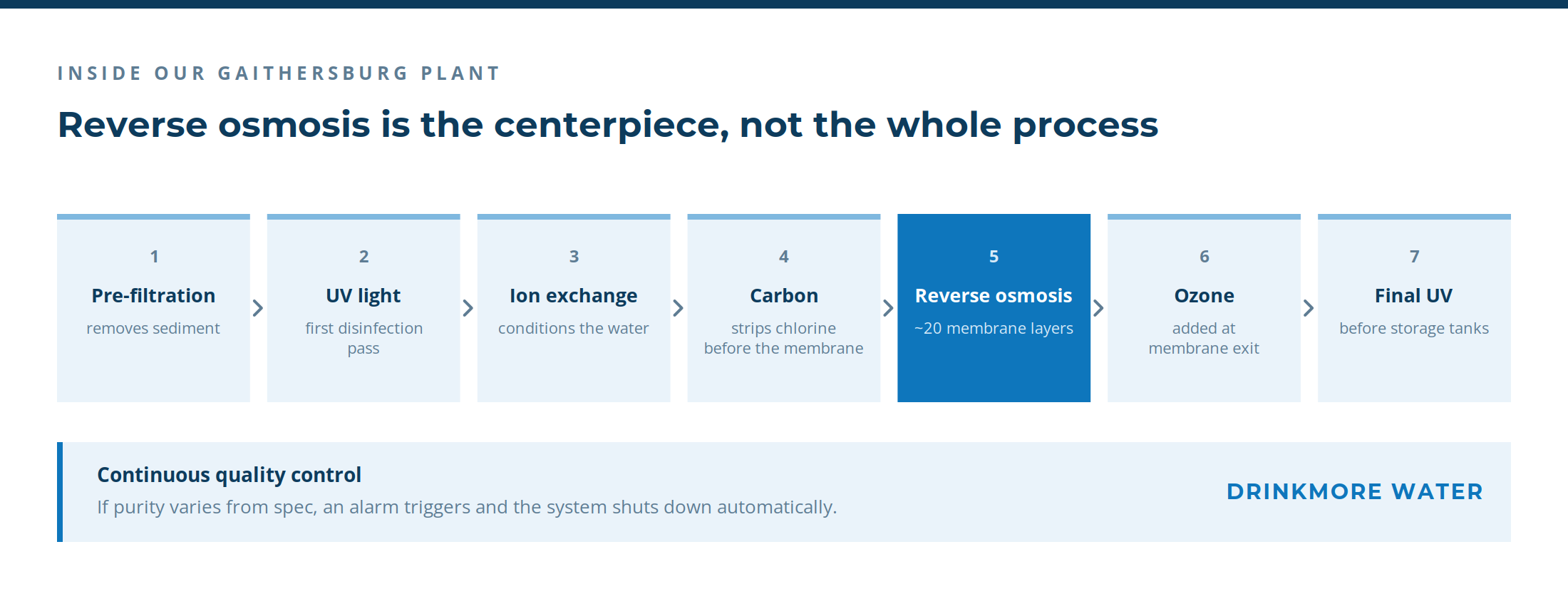
At our Gaithersburg plant, incoming municipal water passes through pre-filtration, UV light, ion exchange, and carbon treatment before it ever reaches a membrane — carbon strips the chlorine that would otherwise destroy the polyamide film. From there, every drop passes through roughly twenty layers of reverse osmosis membranes rather than the single element you’d find under a kitchen sink.
The quality control is continuous. If purity varies even slightly from spec, an alarm triggers and the system shuts down automatically. You cannot bottle out-of-spec water by accident.
After RO, we introduce ozone right at the membrane exit to keep every downstream surface sanitary. Because our process removes all chlorine, we use two chemical-free disinfection technologies instead: ultraviolet light and ozonation. The water passes through UV chambers — including one final pass before it reaches our stainless steel storage tanks — where specific wavelengths destroy the genetic material of any organism present.
Ozone is the second layer. It’s a powerful oxidizer, effective against organisms like Cryptosporidium that shrug off chlorination entirely, and it breaks back down into ordinary oxygen, leaving no residual chemical behind.
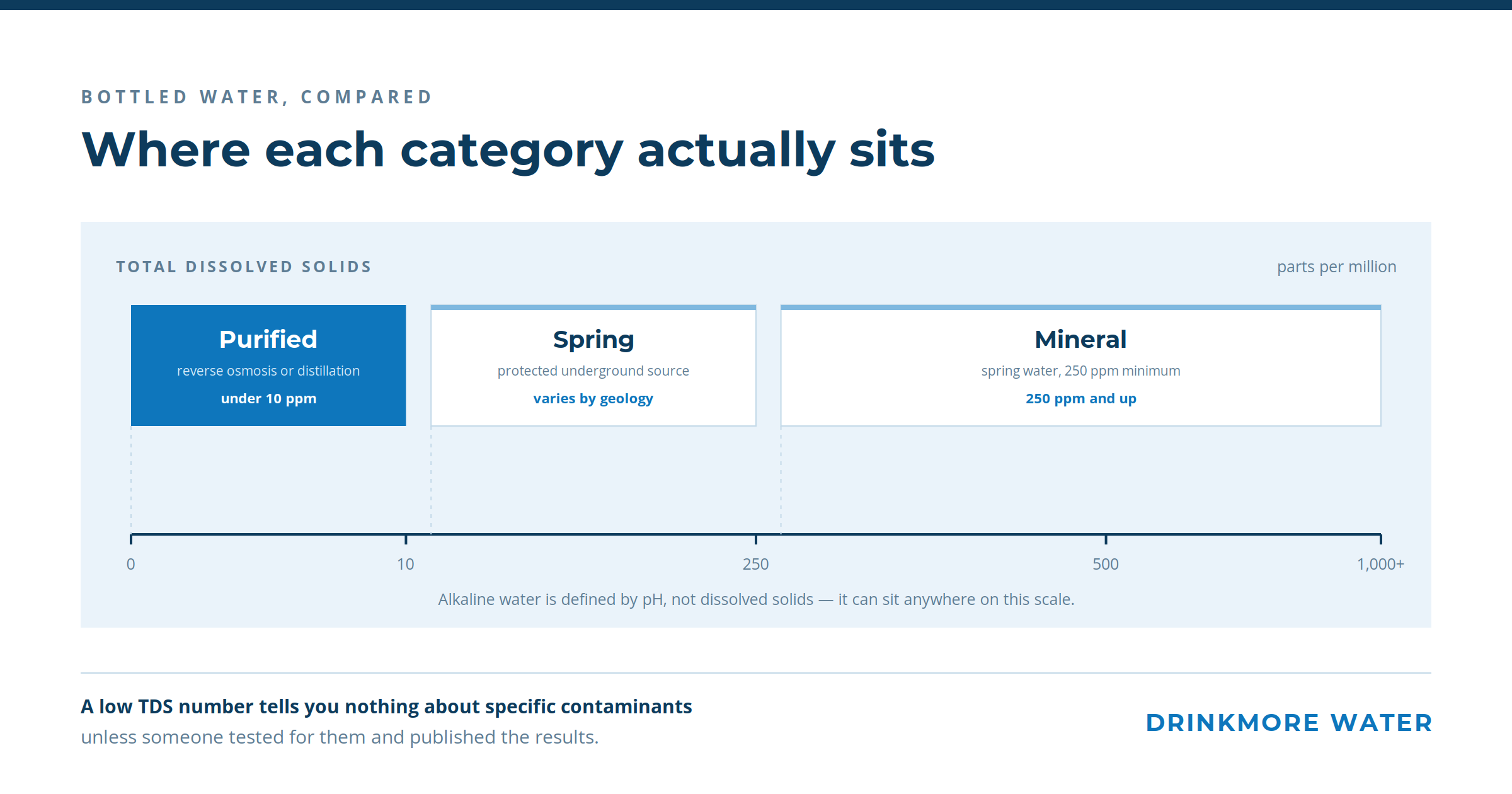
Our finished water is bottled at approximately 1.2 parts per million total dissolved solids. On the 50-state Water Analysis report, it shows as “Not Detected” due to the testing threshold of 10 parts per million. We constantly monitor these numbers within our facility as a sign of overall purification performance.
The full step-by-step walkthrough lives on our water purification process page, and you can see the equipment itself on our bottling plant page.
Independent Verification
We don’t ask anyone to take our word for purity. DrinkMore Water is tested by Eurofins, an independent accredited laboratory, and we publish the results rather than summarizing them. The current report is available on our water analysis page.
In February 2025, DrinkMore Water was awarded the gold medal for Best Purified Drinking Water at the 35th Berkeley Springs International Water Tasting — the longest-running water competition in the world, judged blind by a panel of ten media judges against entries from four continents. It was the first year we entered. Details are on our awards page.
Does Reverse Osmosis Waste Water?
Yes, and it’s a fair criticism of consumer equipment. Reverse osmosis produces a concentrate stream carrying the rejected contaminants, and typical under-sink units discharge three to four gallons for every gallon of purified water they make.
Commercial systems are engineered around this. Larger membrane arrays, staged configurations, and concentrate recovery bring the ratio down substantially compared with residential units — the efficiency gap is one of the real advantages of centralized purification over point-of-use filtration. DrinkMore’s production process has a recovery ratio around 90%.
It’s also worth weighing against the alternative. Distillation achieves comparable purity but requires enough energy to boil every gallon and condense it back. Reverse osmosis reaches the same place at a fraction of the energy cost, which is precisely why we designed our system around it.
Should You Get Reverse Osmosis at Home or Have Purified Water Delivered?
Both routes get you RO water. They differ in what you take on.
An under-sink RO unit means installation, membrane replacement on a schedule, pre-filter changes, and a certain amount of faith that everything is still working correctly between service visits. No one is testing your output.
Delivered purified water shifts the equipment, the monitoring, and the third-party lab testing onto the bottler. You get results you can read.
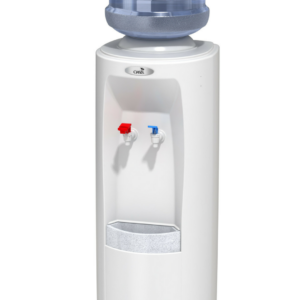
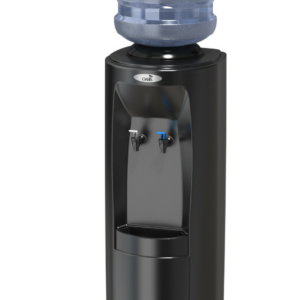
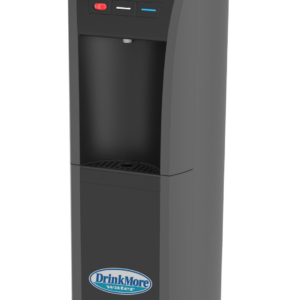
If you’re weighing the options in the DC, Maryland, or Northern Virginia area, our home water delivery service brings RO-purified water to your door, and our bottleless water coolers plumb straight into your line if you’d rather skip bottles entirely. You can also browse our full range of water delivery options to see what fits.
For offices, events, and branded bottles, DrinkMore Custom Water produces the same reverse osmosis water with custom labels.
The Bottom Line on Reverse Osmosis
Reverse osmosis is the most effective broadly available method for removing dissolved contaminants from drinking water, and it’s the foundation of virtually every credible purified water operation — including ours. It removes 95–99% of total dissolved solids, handles metals and PFAS and microbes that simpler filters miss, and does it without the energy cost of distillation.
What it can’t do alone is handle dissolved gases, certain VOCs, or protect itself from chlorine. That’s why reverse osmosis belongs inside a multi-stage process rather than standing on its own.
Frequently Asked Questions
What is reverse osmosis in simple terms?
Reverse osmosis is a purification process that pushes water through a membrane with pores about 0.0001 microns wide. Water molecules pass through; dissolved salts, metals, and chemicals are too large and stay behind. Pressure supplies the force. The result is water with 95–99% of its dissolved solids removed.
Does reverse osmosis remove PFAS?
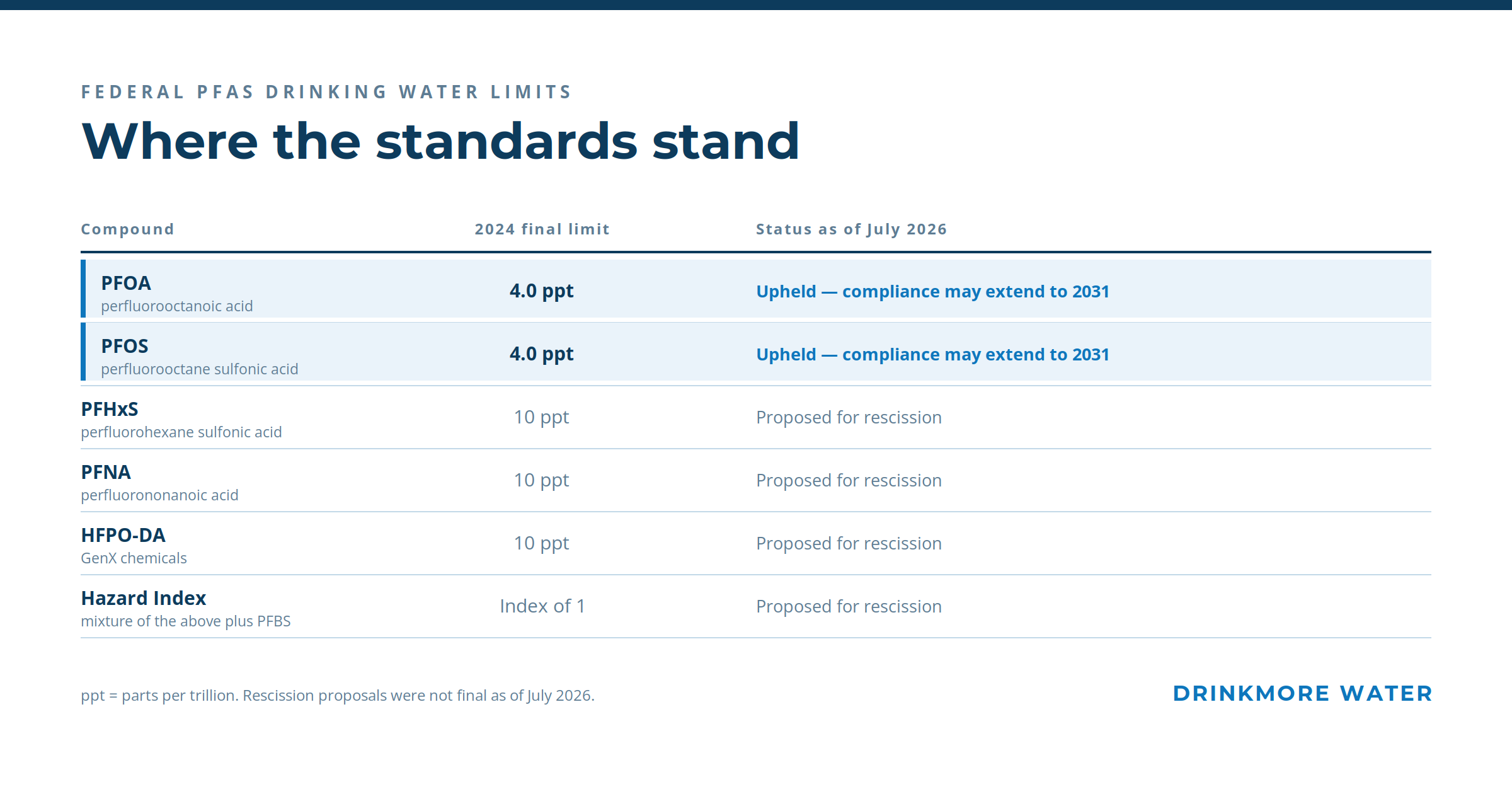
Yes. Reverse osmosis is among the most effective treatments available for PFAS, the family of synthetic “forever chemicals” now regulated in public drinking water. The membrane rejects these compounds along with other dissolved contaminants. RO consistently outperforms standard pitcher and faucet filters, which are not designed to remove PFAS.
Does reverse osmosis remove minerals from water?
Yes. Reverse osmosis removes calcium, magnesium, and other dissolved minerals along with contaminants — the membrane cannot distinguish between them. This is nutritionally minor for most people, since drinking water contributes only a small fraction of dietary mineral intake compared with food.
Is reverse osmosis better than a carbon filter?
They do different jobs. Carbon filters excel at removing chlorine, taste, and odor compounds but leave dissolved solids, metals, and salts untouched. Reverse osmosis removes those dissolved contaminants. Well-designed systems use both — carbon first to protect the membrane, then RO for broad-spectrum removal.
How long do reverse osmosis membranes last?
Residential RO membranes typically last two to five years depending on source water quality, pre-filtration, and usage. Pre-filters need replacing far more often, usually every six to twelve months. Skipping pre-filter changes shortens membrane life considerably, since chlorine and sediment reaching the membrane damage it.
Does reverse osmosis water taste different?
Most people find it tastes cleaner and more neutral. Removing dissolved solids removes the chlorine, metallic, and mineral notes that give tap water its local character. Taste is subjective, but blind panels do reward it — DrinkMore Water’s RO water took gold in the purified category at the 2025 Berkeley Springs International Water Tasting.
What to Expect
Discover the Difference

30 years Experience

Fast Turnaround Time

Excellent Customer Service

State-Of-The-Art Purification

Made in the USA

Delivered to you!
Testimonials

“10 out of 10. Delivery guy is the best!”
“Excellent water, excellent service all around! Have been using them for years.”
“Very reliable company. Delivers as promised.”
“Everyone here is always nice and accommodating. Never waited and I get unloaded quickly.”
Request Form
We would love to hear from you! Please fill out this form and we will get in touch with you shortly.