What Is the Best Water to Drink?
What Is the Best Water to Drink?
The best water to drink is water that’s free of contaminants, tastes good enough that you drink enough of it, and fits your budget. For most households that means purified water — treated by reverse osmosis or distillation to remove 95–99% of dissolved solids — or a well-maintained filtration system on a municipal supply that already meets EPA standards.
The rest of this guide explains how each type differs and how to decide between them, without pretending there’s one universally correct answer.
Why Does “Best Water to Drink” Have More Than One Answer?
Because people are optimizing for different things.
Someone concerned about lead in older plumbing has a different problem than someone who simply dislikes the chlorine taste in their tap water. Someone in an area with documented PFAS detections has a different problem than someone whose utility reports clean results across the board.
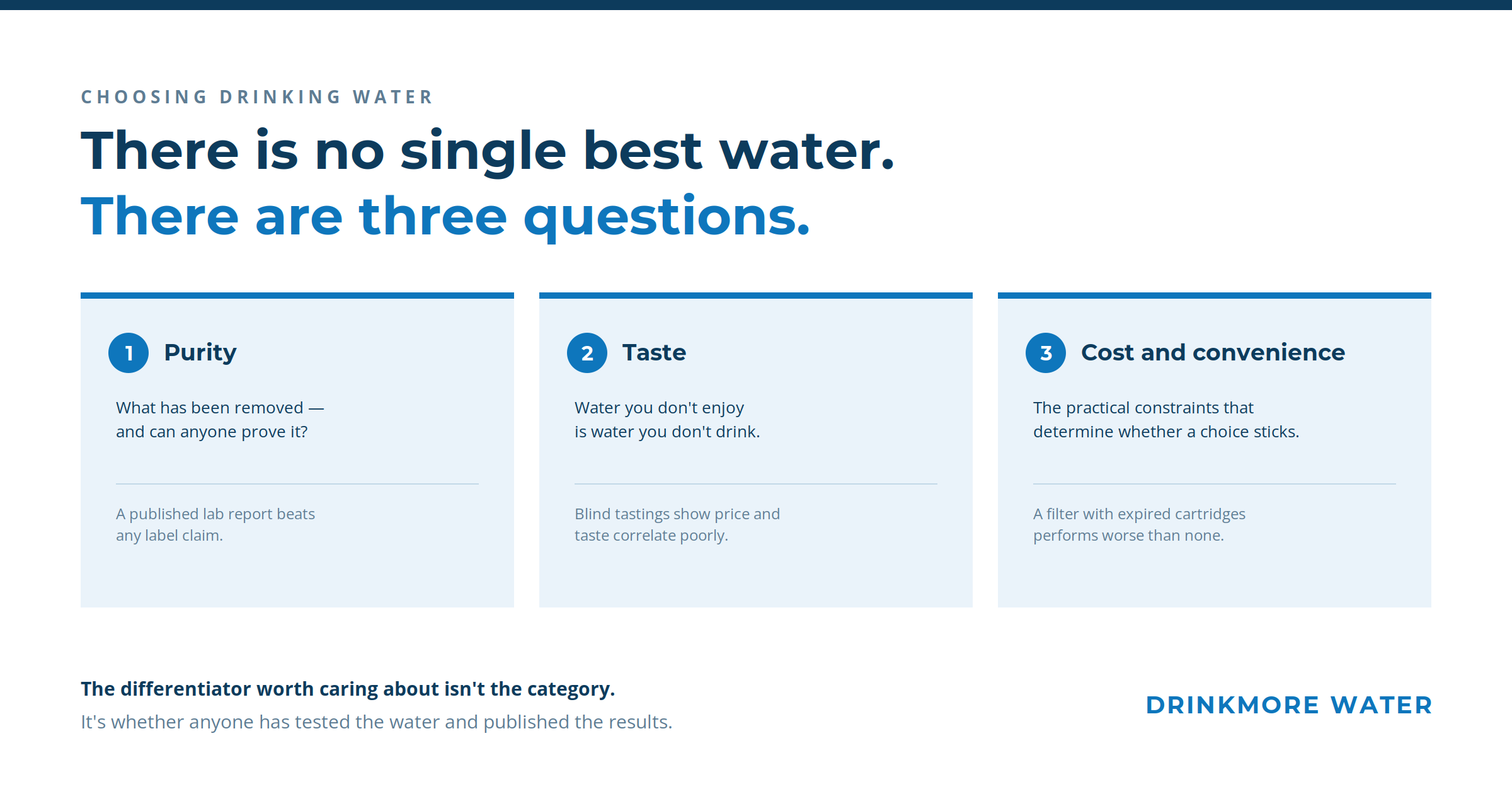
So instead of naming a winner, this guide breaks down what each category actually delivers. Three criteria do most of the work:
Purity — what’s been removed, and can anyone prove it? Taste — because water you don’t enjoy is water you don’t drink. Cost and convenience — the practical constraints that determine whether a choice sticks.
Types of Drinking Water Compared
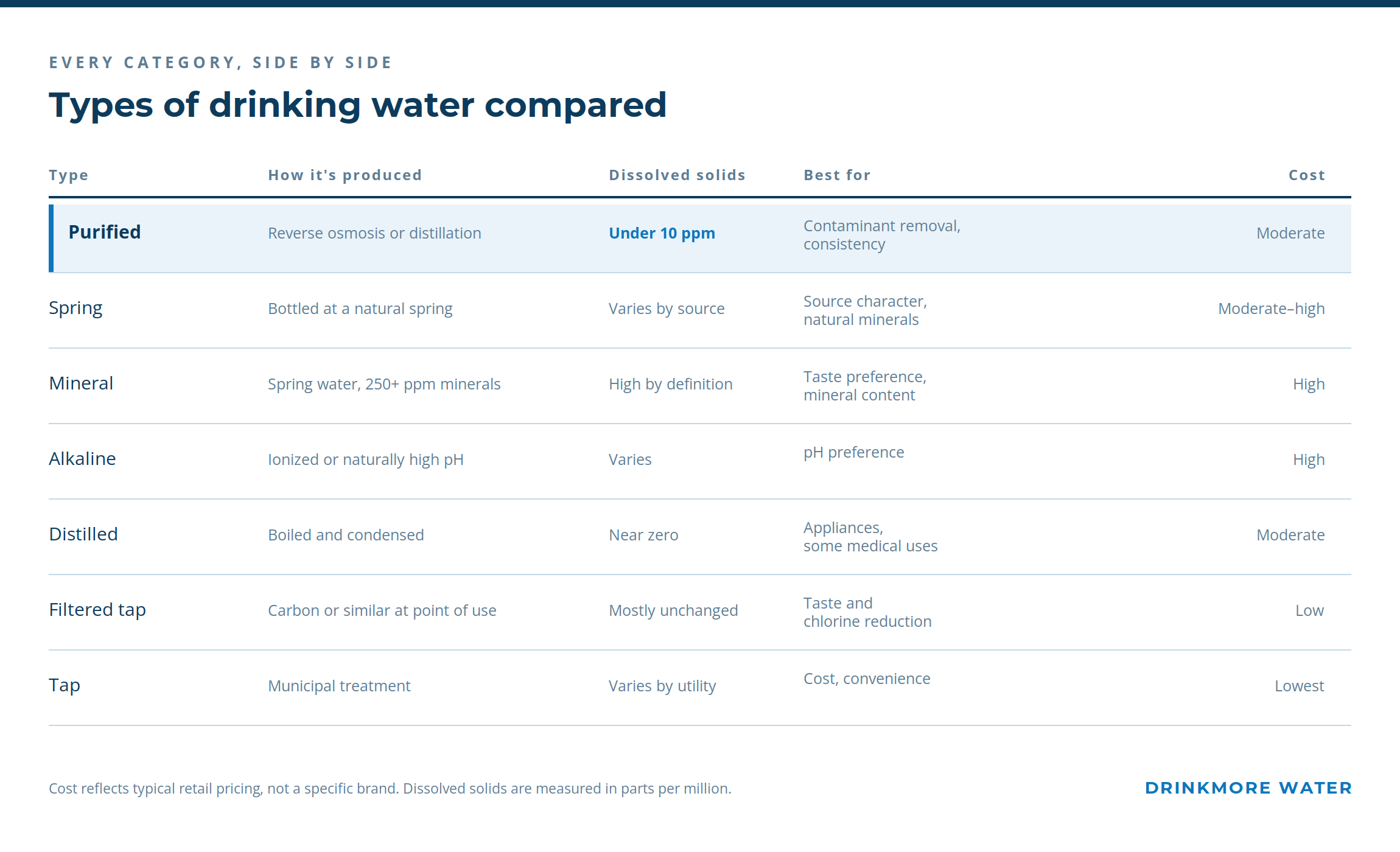
Our pillar guide to the types of water covers each of these in more depth.
Is Tap Water Good Enough to Drink?
In most of the United States, yes — with caveats worth understanding.
Municipal water in the DC, Maryland, and Northern Virginia area is regulated under the Safe Drinking Water Act, tested continuously, and treated to remove pathogens and reduce contaminants below federal limits. Utilities publish annual Consumer Confidence Reports showing exactly what they detected.
Two caveats matter.
Your pipes are not your utility’s pipes. Water can leave a treatment plant meeting every standard and pick up lead or copper from service lines and household plumbing on the way to your faucet. Homes built before 1986 are the ones to check.
Some contaminants weren’t part of the original design brief. Conventional municipal treatment targets pathogens, turbidity, and disinfection byproducts. It was never built to remove dissolved synthetic compounds at parts-per-trillion concentrations. That’s why the PFAS treatment buildout is happening now, on a compliance timeline running to 2029 or 2031.
Our guide to what’s in tap water walks through the full contaminant picture, and purified water vs. tap water compares them directly.
Is Purified Water the Healthiest Water to Drink?
Purified water is the most consistently clean water, which is a narrower claim than “healthiest” and a more defensible one.
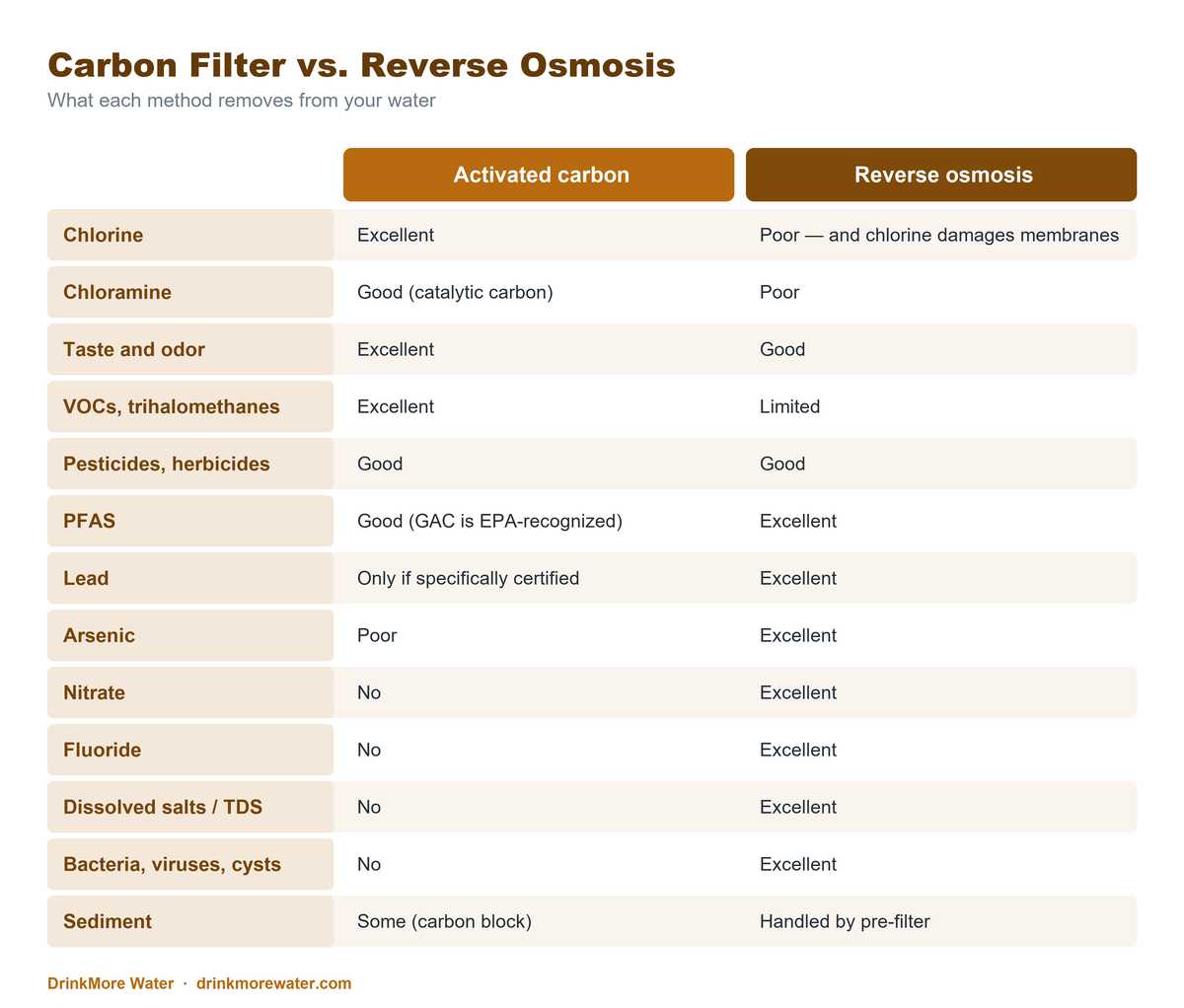
Reverse osmosis removes 95–99% of total dissolved solids: heavy metals like lead and arsenic, nitrate, PFAS, pesticide residues, pharmaceutical traces, and microbiological contaminants. Distillation achieves similar results by a different route.
What purified water does not do is add anything beneficial. It’s water with the contaminants taken out. Any brand claiming purified water delivers health benefits beyond hydration and contaminant removal is overselling.
Does Removing Minerals Matter?
This is the standard objection to purified water, and it deserves a direct answer.
Reverse osmosis removes calcium and magnesium along with everything else dissolved in the water. The membrane can’t distinguish beneficial minerals from harmful ones.
Nutritionally, this is a small effect for most people. Drinking water is a minor contributor to mineral intake compared with food — the calcium in a liter of typical tap water is a fraction of what a serving of dairy or leafy greens provides. If your diet is reasonably varied, purified water doesn’t change your mineral status meaningfully.
We examine the research in our article on minerals in drinking water.
What About Alkaline Water?
Alkaline water has a pH above roughly 8, either naturally or through electrolysis.
The marketing claims — that it neutralizes body acidity, improves hydration, or slows aging — run well ahead of the evidence. Your body regulates blood pH within a very narrow range regardless of what you drink, and stomach acid neutralizes alkaline water on arrival.
Some people prefer the taste. That’s a legitimate reason to buy it. The health claims are a different matter, and we go through them in our guide to alkaline water.
Is Distilled Water Good to Drink?
Distilled water is safe to drink and extremely pure — boiling and condensing leaves nearly all dissolved solids behind.
Most people find it flat-tasting, since the dissolved minerals contributing to water’s taste are gone. It’s more commonly used in steam irons, CPAP machines, humidifiers, and laboratory applications than as everyday drinking water.
Distillation and reverse osmosis reach comparable purity, but distillation requires enough energy to boil every gallon and condense it back. RO gets to the same place at a fraction of the energy cost — which is why we designed our plant around it. See distilled vs. purified water for the full comparison.
What’s the Best-Tasting Water?
Taste is subjective, but it can be evaluated systematically.
The Berkeley Springs International Water Tasting has run annually since 1991 and is the largest competition of its kind. Ten trained media judges evaluate entries blind across five criteria: appearance, aroma, taste, mouthfeel, and aftertaste. Waters compete within their category, so purified water is judged against purified water.
At the 35th competition in February 2025, DrinkMore Water won the gold medal for Best Purified Drinking Water against more than 80 entries from four continents. It was the first year we entered.
What blind tastings consistently reveal is that price and taste correlate poorly. Regional and inexpensive waters often outscore premium imports once judges can’t see the bottle.
If you’re choosing on taste, the practical approach is to try a few and notice which one you actually reach for.
How Much Water Should You Drink?
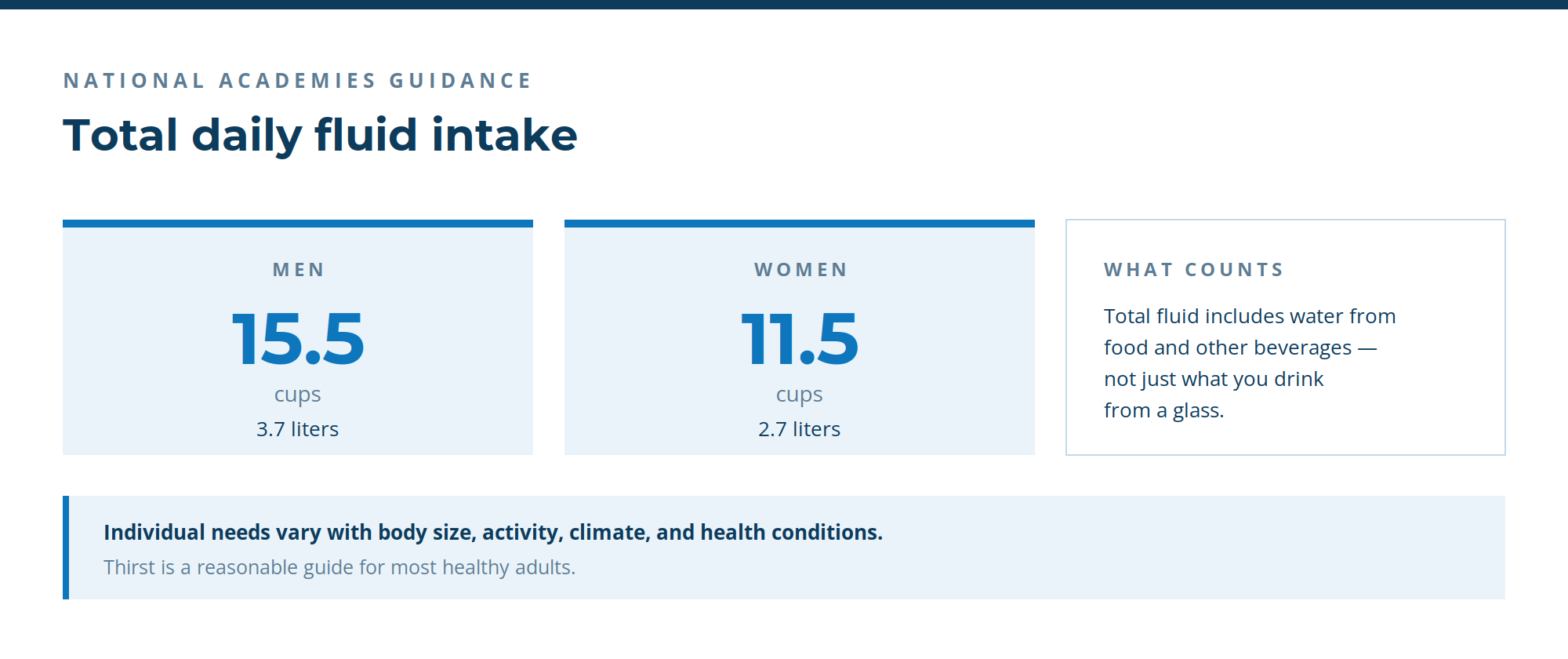
Common guidance is around 15.5 cups (3.7 liters) of total daily fluid for men and 11.5 cups (2.7 liters) for women, per the National Academies. “Total fluid” includes water from food and other beverages, not just what you drink from a glass.
Individual needs vary with body size, activity level, climate, and health conditions. Thirst is a reasonable guide for most healthy adults.
The practical point for this article: the type of water matters far less than the amount. Water you enjoy and keep accessible is water you’ll actually drink. If switching to purified water means you reach for the glass instead of the soda, that’s a bigger effect than any difference between water categories.
How to Choose the Best Water for Your Household
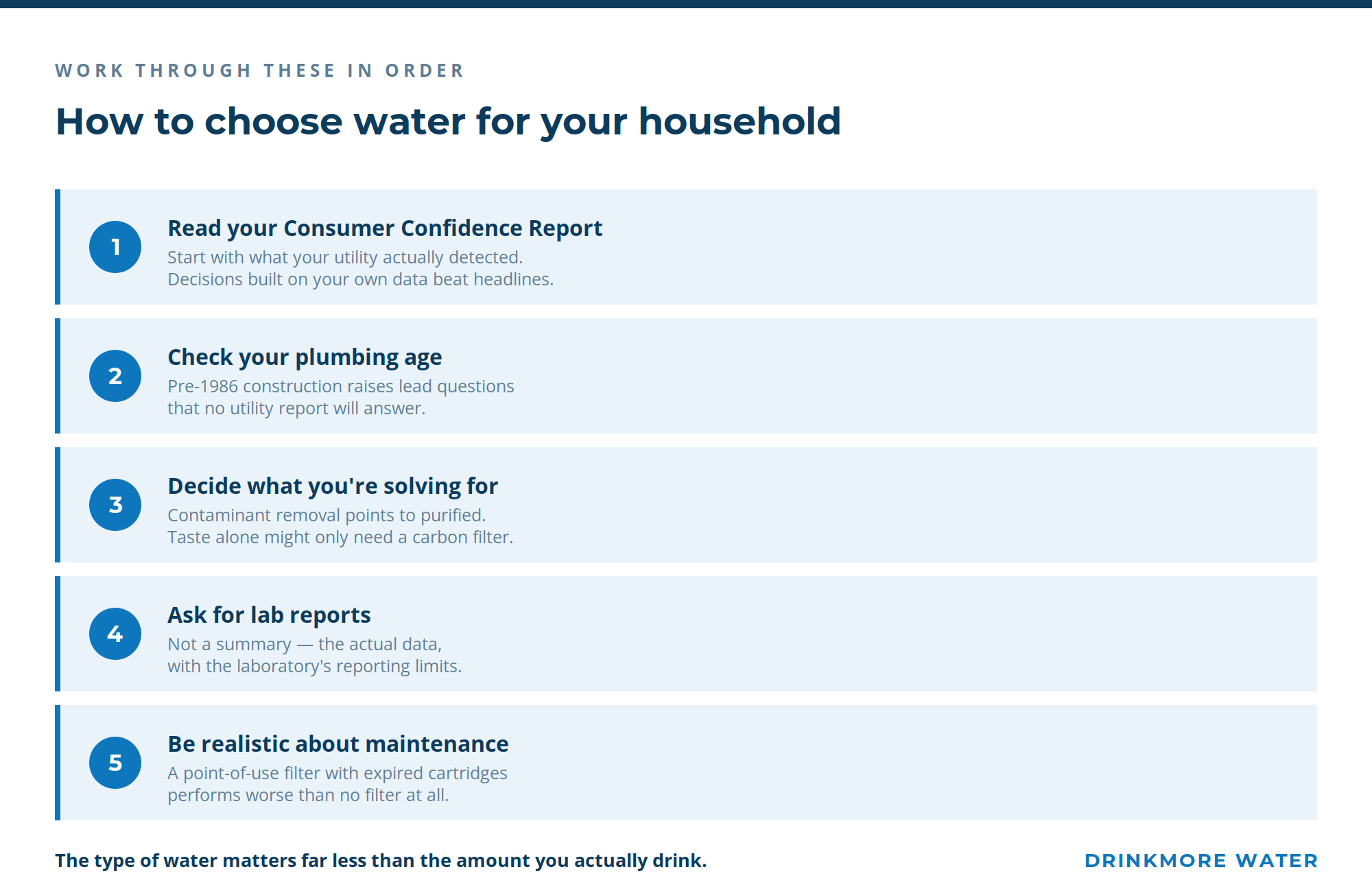
Work through these in order:
Getting Purified Water Delivered in DC, Maryland, and Virginia
If purified water is where you land, delivery removes the recurring chore of carrying cases home.
DrinkMore Water purifies by reverse osmosis at our plant in Gaithersburg, Maryland, then disinfects with ultraviolet light and ozone rather than chlorine. Every drop passes through roughly twenty layers of RO membranes, and the system shuts down automatically if purity drifts from specification. The full process is on our water purification process page, and our independent Eurofins lab results are published in full on our water analysis page.
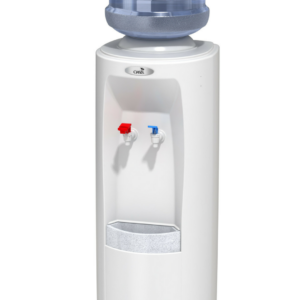
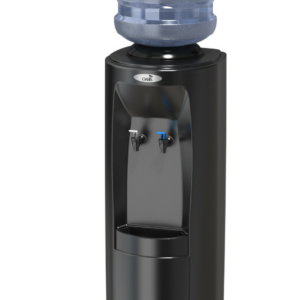
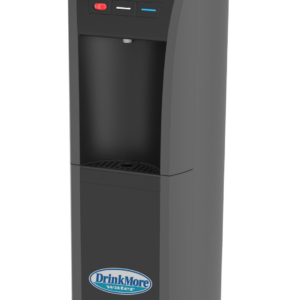
Our home water delivery service covers households across the region, and our bottleless water coolers plumb into your existing line if you’d rather skip bottles. Both are at DrinkMore Water. For offices, events, and branded bottles, DrinkMore Custom Water offers the same water with custom labels.
Worth trying a few options before committing to any of them, ours included.
The Bottom Line: What Is the Best Water to Drink?
The best water to drink is clean, verified, and something you’ll actually consume in adequate quantity. Purified water offers the most thorough contaminant removal and the most consistent product. Spring and mineral water offer source character and dissolved minerals. Tap water is the most economical and, in most of this region, meets federal standards.
The differentiator worth caring about isn’t the category — it’s whether anyone has tested the water and published the results.
Frequently Asked Questions
What is the healthiest water to drink?
Purified water removes the most contaminants — reverse osmosis eliminates 95–99% of dissolved solids including lead, arsenic, PFAS, and nitrate. No water type provides health benefits beyond hydration and contaminant removal, so “healthiest” in practice means “cleanest.” Claims that specific waters cure conditions or alter body pH are not supported by evidence.
Is purified or spring water better to drink?
Neither is universally better. Purified water is more consistent and far lower in dissolved solids, since reverse osmosis removes contaminants and minerals alike. Spring water retains source minerals and a distinctive taste but varies seasonally and receives minimal treatment. Choose based on whether you prioritize consistency or source character.
Is it safe to drink tap water in Maryland and Virginia?
Municipal water throughout the DC, Maryland, and Northern Virginia area is regulated under the Safe Drinking Water Act and tested continuously. Utilities publish annual Consumer Confidence Reports. The main gaps are household plumbing — lead from pre-1986 service lines — and PFAS, which conventional treatment wasn’t designed to remove.
Does alkaline water have real health benefits?
Evidence for the marketed claims is weak. Your body maintains blood pH within a narrow range regardless of what you drink, and stomach acid neutralizes alkaline water on ingestion. Some people prefer the taste, which is a reasonable reason to buy it. Claims about neutralizing body acidity are not well supported.
How much water should I drink each day?
The National Academies suggest roughly 15.5 cups (3.7 liters) of total daily fluid for men and 11.5 cups (2.7 liters) for women, including water from food and other beverages. Individual needs vary with activity, climate, body size, and health conditions. Thirst is a reasonable guide for most healthy adults.
Is bottled water better than filtered tap water?
It depends on the bottler and the filter. A well-maintained reverse osmosis system at home and RO-purified bottled water produce comparable results. Bottled delivery shifts equipment maintenance and third-party lab testing to the supplier; home filtration is cheaper but only works if cartridges are replaced on schedule.
What to Expect
Discover the Difference

30 years Experience

Fast Turnaround Time

Excellent Customer Service

State-Of-The-Art Purification

Made in the USA

Delivered to you!
Testimonials

“10 out of 10. Delivery guy is the best!”
“Excellent water, excellent service all around! Have been using them for years.”
“Very reliable company. Delivers as promised.”
“Everyone here is always nice and accommodating. Never waited and I get unloaded quickly.”

Request Form
We would love to hear from you! Please fill out this form and we will get in touch with you shortly.